A furry friend who was blowing in the wind when I met him/her.


I have some cute tiny birds that visit the trees (bare in winter of course) outside my windows over the laptop screen. Sometimes I try to take their photos...usually pretty sad results.

Big Windy had hoarfrost showing early on last Monday morning.


He was all fluffed up and kept coming back to that branch all day long. Silly guy wasn't even in warm sunshine most of the time.
 Our smattering of snow Wed. morning last...melted away by noon and that was all we got here!

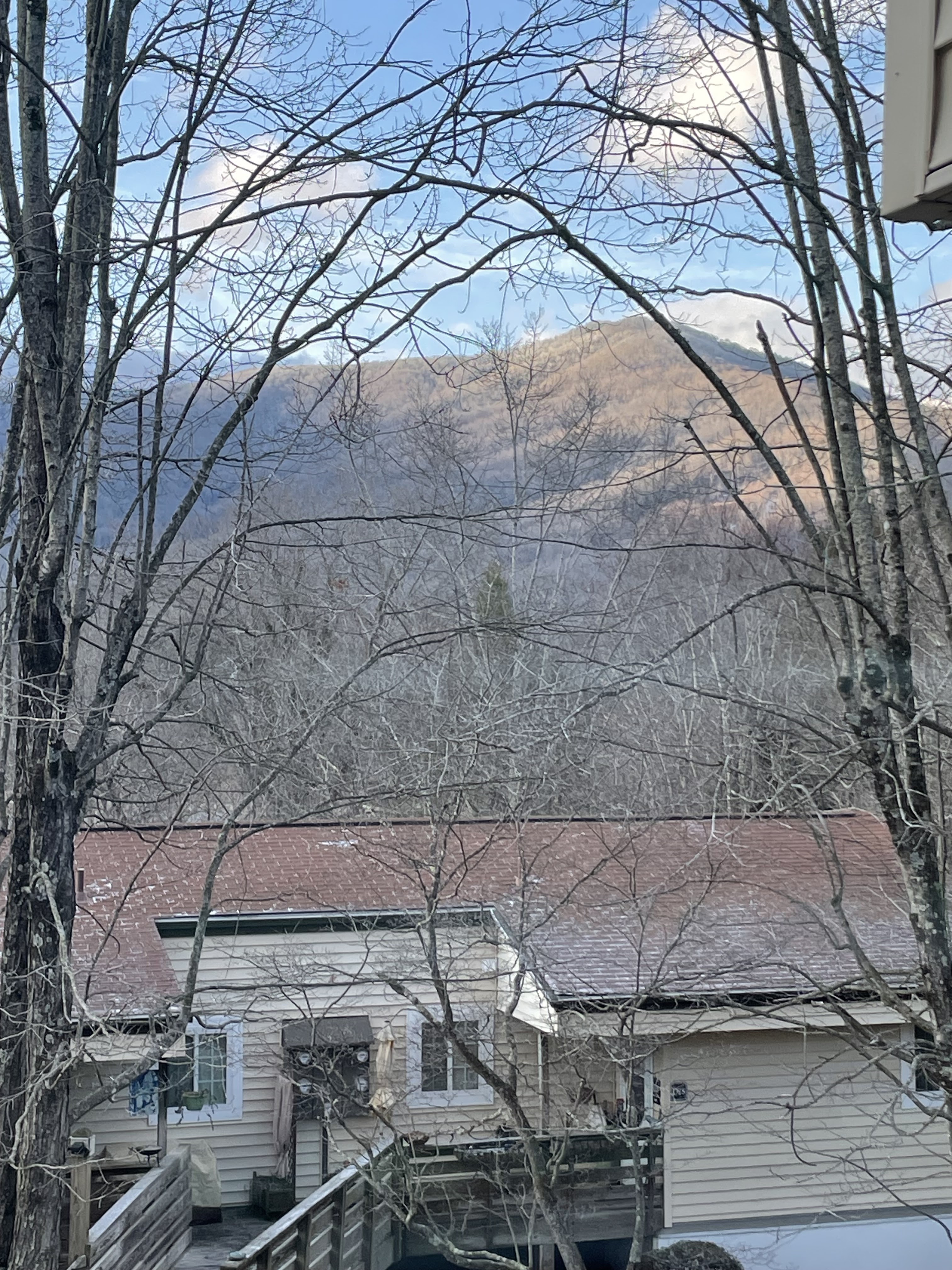
Thursday morning Big Windy showed a bit of snow, and neighbor's roof had either frost on snow...so grateful not to be snowed in, but actually I was "cold-in," and didn't go out till Friday (except to get the mail wearing my big coat)
------------------
Sharing with Saturday's Critters
----------
Today's notes on politics: (which I mainly post to have as a journaled record of what these crazy times are experiencing!)
From PBS News Tues. Feb. 18, 2025 - 9:55 pm
Let’s look at some of the facets of the federal workforce that have lost staff. Consider this a snapshot of the landscape right now, with the caveat that more actions may take place after this week’s email.
- U.S. Forest Service: 3,400 workers laid off
- Department of Energy: some 1,000 workers laid off
- Veterans Affairs: more than 1,000 workers fired
- National Institutes of Health: Between 1,000 and 1,200 workers fired
- Bureau of Land Management: 800 workers fired
- National Park Service: 1,000 workers fired
- Centers for Disease Control and Prevention: About 750 workers fired
- Small Business Administration: About 720 workers fired
- Federal Aviation Administration: About 400 workers fired
- Environmental Protection Agency: About 400 workers fired
- Federal Emergency Management Agency: More than 200 workers fired
Other agencies, such as the General Services Administration, Cybersecurity and Infrastructure Security Agency, U.S. Citizenship and Immigration Services, and the Department of Education, have had dozens of staffers cut.The hardest hit agency. Currently the largest source of layoffs is the U.S. Agency for International Development.So far, more than 12,000 American workers — most of them contractors — have been laid off, according to Stop-WorkUSAID, a group tracking the cuts. Organizer Sadie Healy told us they tallied this figure based on individual names they have vetted. The actual total is likely larger, she said.Thousands more at USAID are also under a stop-work order and face potential firing, depending on a court ruling, which has frozen action against them for the moment.

----------------
Today's quote:
A memory may feel abstract or immaterial, but it is actually a biochemical process taking place in the brain. It involves neurons communicating with each other via the “wires” or synapses connecting them. The pathway an electrochemical signal follows as it continually travels from neuron to synapse to neuron constitutes a memory.
Whenever you have that memory, the same pathway gets activated. And the more it’s activated, the more it becomes hardwired into the brain’s circuitry. Eventually, it becomes a long-term memory.
Activation also requires enzymes, molecules that set off chemical reactions. The problem is that these enzymes don’t exist for longer than a week. If a memory is to endure, it would seem that the enzymes would have to remain functioning for years or even decades.
Once the enzymes turn off, one would expect the memories to go with them. “This became a holy grail in neuroscience,” Lisman says. “How can a molecule in your brain serve as a memory? How does nature accomplish this?”
—John Lisman
Thanks to fellow blogger, Love is a Place,
I'm quite relieved to know why my brain has such trouble these days!
------------
Today's art:

Noelle E. DeVito




.jpg)





%201876%20-%201958.jpg)