A post from June, excerpts from another blog, Notes on the History of Randolph County which details some historic information about The Conjurer.
Dancing native named “the flyer,” “the magician,” or “the sourcerer.” - painting of a Native by European, John White in 1585 near the town of Secotan on the Pamlico River, with Sir Walter Raleigh's explorers of what would become North Carolina.L. McKay Whatley in this blog speaks of...
"... a unique episode of Randolph County history that opens up a window into the cultural life of local African Americans in colonial times. Very little information survives about individual Randolph County’s black population before 1800, but the most interesting fragment is found in an unusual place- the Narrative of Colonel David Fanning, the leader of the pro-British forces that waged a deadly guerrilla war in Randolph county in 1781 and 1782,
In May 1781 Fanning attacked a column of NC Dragoons under a Colonel Dudley, coming up the PeeDee Road from Camden, killing several men, taking prisoners and stealing their baggage train. Colonels Collier and Balfour tracked Fanning back to his headquarters at Cox’s Mill on Deep River, and “kept a constant scouting” to provide information back to the colonial forces. Several months later, Colonel Dudley with “300 men from Virginia” attacked Fanning’s fortified position at the mill, scattering the loyalist forces and taking control of Fanning’s supplies. Writes Fanning, “He took a negro man from me and sold him at public auction for 110 pounds; the said negro was sent over the mountains, and I never saw him since.” [The Narrative of Colonel David Fanning (1865), p. 17]
Fanning mentions owning a number of Negroes but this one was particularly important to him. An offhand mention in a report to General Butler, commander of the state militia, may indicate why. “Captain Henley… was in action with Fanning. Twelve surprised eighteen, killed six, and took three prisoners and a Negro, the Conjuror.” [Executive Letter Book, March 1st, 1782]
Very few enslaved people are known by name from the 18th century, but even fewer are known by a title. This title, “the Conjuror,” seems simple but provides a window into the African heritage of the enslaved in this county that has never before been opened.
In the Bible, “to conjure” means to summon or invoke a spirit or devil by magic or sorcery. The online Free Dictionary goes on to state that a conjuror, also called a witch doctor, root doctor, jujuman or obeaha, “is a priest and physician called upon by African tribal members and followers of religions such as voodoo, Santeria and macumba.” [https://www.thefreedictionary.com/conjure+man] It is based in the belief that psychic powers can be used in a way to cast spells, make enchantments, find lost items, detect thieves, tell the future, create good or bad luck, and even heal or kill.
Native conjurers were present in 1585 when the men of Sir Walter Raleigh arrived in North Carolina. Visiting the town of Secotan on the Pamlico River, the artist John White painted a dancing native he named “the flyer,” “the magician,” or “the sourcerer.”
Most conjures do not seem to have had an evil purpose; many practitioners functioned as doctors or nurses to the enslaved community using elements of African and European folk medicine and native herbal lore. The tradition of “working the roots” was common in rural North Carolina up into the 21st century, although not commonly known to white Southerners....it is believed to have its origins in the folk beliefs of West Africa, home of many in the enslaved population. [https://www.ncpedia.org/root-doctors]
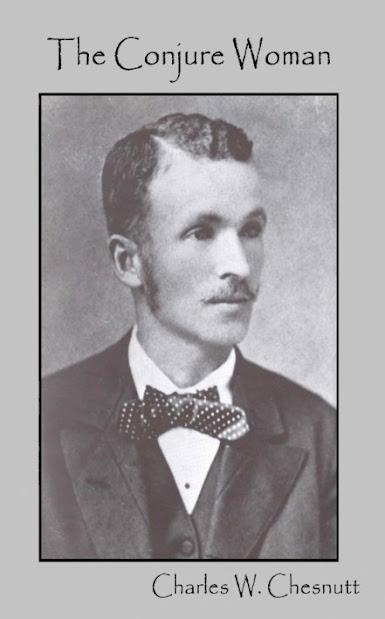
The conjure culture of Piedmont North Carolina also inspired one of the first popular works of African-American literature. Charles Waddell Chesnutt (1858-1932), a son of free people of color from Fayetteville, NC, began writing short stories in 1887. His “The Goophered Grapevine” was the first work by an African American to be published in The Atlantic Monthly. His collected stories were published in 1899 as The Conjure Woman, which was adapted at a motion picture in 1926. He contributed to The Atlantic for more than 20 years, also writing a biography of Frederick Douglas and a novel based on the Wilmington Massacre of 1898
It’s hard to draw a full portrait of a man with no more information than his title “Conjuror;” but much of early African American culture is based on such bits and pieces of surviving facts. Without this tidbit, we would have no way of knowing that the enslaved peoples of Randolph County shared the conjure culture rooted in West Africa.
I know a Wiccan, priestess of that religion. She writes books about appalachian stories and charms, and maybe even spells. Many are among the traditional healing ways of the elder women of this area. I've attended several rituals that she shared which were very inspirational. H. Byron Ballard is sometimes known as the Village Witch of Asheville, NC.
Here's her latest book due to be out soon.
Sharing with Sepia Saturday this week.
Today's quote:
A child upon seeing a grand mosque exclaimed, / God, just one of you and such a big house!
-Nida Fazli, poet (1938-2016)