Update about blog

photo from the internet
Showing posts with label mothers. Show all posts

Sunday, May 10, 2026

Happy Mother's Day

Happy Mother's Day to all mothers...as well as all women who have been creative through other avenues, like poets, painters, potters, musicians, planters, and pet owners!

Bathing a newborn - unknown photographer 


My name is Barbara Booth
the daughter of
Mataley Mozelle,

the daughter of
Mozelle Booth,

the daughter of
Eugenia Almeda,
the daughter of
Eugenia Almeda, (yes there were 2!)

daughter of
Susan Elizabeth,

daughter of
Elizabeth...

This is my lineage of mothers. To their spirits I send wishes for Happy Mothers Day.


My grandmother Mozelle Booth and myself (maybe age 3). Grandmommy was a single mother most of her life, and supported herself as a seamstress, working mainly on society women's beautiful gowns for dances and weddings and other events in San Antonio TX. She made the coat, leggings and hat outfit for myself. It was tan wool with a brown velvet collar.


My Great Grandmother, after whom I was named. A cousin had been given her first name as her middle name, so when I came along, I was told, I received her maiden name. Later I noted that my grandmother had also had Booth as a middle name, so I didn't mind quite as much. Living in Texas until I was 8, I never knew a thing about John Wilkes Booth until moving to St. Louis and learning that he killed Lincoln, who had actually been pretty unpopular with the south. I have copies of letters from ancestors at the time he had been elected just before the Civil War...those Texans sure didn't like him. However, as an adult I've traced my Booth family lineage and find no direct connection to the Booths of theatrical fame, nor to the assassin, John Wilkes.


"Gummy" my grandmother (visiting from Houston TX), my father (her son), and my mother. This was our first owned house in St. Louis. My mother worked full time at the private school, Principia. My father did also. Gummy was a Christian Science practitioner, and greatly influenced my parents to bring my sister and myself to Principia, the Christian Science school grades K-12 and college in Elsah IL. It was a dedication which they gave us, and we never appreciated it as much as they hoped, both of us leaving the religion shortly after quitting college in our 3rd years.

"Dear Nan" Zulieka, my great grandmother on my fathers side, holding my father's sister who died young.
--------------------------

Yearbook picture of my mother


Studio type photo with same hairdo of my mother


Two good friends who share day trips and conversations over coffee often, where our children, grandchildren and books are often the topics discussed.

My grandson Michael and Amanda who will be having their baby this October, my first great grandchild! So Amanda is also wished a happy almost Mother's Day.


And again, to offer wishes that all creative mothering energies are appreciated! Nurturing and creativity are not at all passive feminine acts. 

I am learning a lot about women's energies from "Sand Talk: How Indigenous Thinking Can Save the World" by Tyson Yunkaporta. The following is a quote from this book, from "Kelly Menzel, an Aboriginal woman from the Adelaide Hills (Australia) and keeper of ancestral Indigenous Knowledge. She is a nurse by Trade and a healer by vocation who is completing her PhD and working as a university lecturer." The question is whether to reverse the domesticated state as evident in our present society's way of defining women's and men's relationships.


This mother gifted herself with a fresh haircut for Her Day!


Monday, January 12, 2026

Dr. Katie Hinde

The world's first food (for mammals anyway)...mother's milk.


"When a baby gets sick, small amounts of the baby's saliva travel back through the nipple during nursing into the mother's breast tissue. That saliva contains information about the baby's immune status. If the baby is fighting an infection, the mother's body detects the antigens and begins producing specific antibodies—which then flow back to the baby through the milk within hours. Once the baby recovered, everything would return to normal. It was a dialogue. The baby's body communicated its needs. The mother's body responded."
Above quote is from a recent post by What Did I Just See? about the revolutionary research of scientist Katie Hinde:
"In 2008, a scientist stared at monkey milk and realized: we've been missing half the conversation. What she discovered changed everything we thought we knew about the world's first food.
Katie Hinde stood in a California primate research lab surrounded by hundreds of milk samples, running the same analysis for the hundredth time. She kept rechecking her data because what she was seeing seemed impossible.
Rhesus macaque mothers were producing completely different milk depending on whether they'd given birth to sons or daughters.
Sons received milk with higher concentrations of fat and protein—more energy per ounce, built for rapid growth. Daughters received larger volumes of milk with higher calcium levels—engineered for faster skeletal development. The biological recipe wasn't universal. It was customized.
Male scientists dismissed it. "Measurement error," they said. "Random variation."
But Katie Hinde trusted the math. And the math was screaming something revolutionary: milk wasn't just food. It was a message.

For decades, science had treated breast milk like fuel—a simple delivery system for calories, proteins, and fats. But if milk was just nutrition, why would it differ based on the baby's sex? Why would mothers unconsciously adjust the formula?
Hinde kept digging. She analyzed milk from over 250 rhesus macaque mothers across more than 700 sampling events. And with each discovery, the picture became clearer—and more astonishing.
Young, first-time monkey mothers produced milk with fewer calories but dramatically higher levels of cortisol (the stress hormone). Babies who consumed this high-cortisol milk grew faster but were more nervous, more vigilant, less confident. The milk wasn't just feeding the baby's body—it was programming the baby's temperament.
------------------
Then came the discovery that seemed almost impossible to believe. When a baby gets sick, small amounts of the baby's saliva travel back through the nipple during nursing into the mother's breast tissue. That saliva contains information about the baby's immune status. If the baby is fighting an infection, the mother's body detects the antigens and begins producing specific antibodies—which then flow back to the baby through the milk within hours.
The white blood cell count in milk would jump from 2,000 cells per milliliter to over 5,000 during acute illness. Macrophage counts would quadruple. Then, once the baby recovered, everything would return to normal.
It was a dialogue. The baby's body communicated its needs. The mother's body responded. Hinde had discovered a language that had been invisible to science.

----------------
In 2011, she joined Harvard University as an assistant professor. But as she dug into the research literature, she found something disturbing: there were twice as many studies on erectile dysfunction as on breast milk composition.
The world's first food—the substance that had nourished every human who ever lived—was scientifically neglected. She started a blog with a deliberately provocative title: "Mammals Suck...Milk!" Within a year, it had over a million views. Parents, clinicians, and researchers began asking questions science hadn't bothered to answer.
Her research exploded with discoveries:
Milk changes across the day (fat concentration peaks mid-morning). Foremilk differs from hindmilk (babies who nurse longer get higher-fat milk at the end). More than 200 varieties of oligosaccharides exist in human milk—and babies can't even digest them. They exist solely to feed beneficial gut bacteria and prevent harmful pathogens from establishing. Every mother's milk is as unique as a fingerprint—no two mothers produce identical milk, no two babies receive identical nutrition.
------------

In 2013, she created March Mammal Madness, a science outreach event that became an annual tradition in hundreds of classrooms. In 2016, she received the Ehrlich-Koldovsky Early Career Award for making outstanding contributions to lactation research.
By 2017, when she delivered her TED talk "What we don't know about mother's milk," she could articulate a decade of revolutionary findings: Breast milk is food, medicine, and signal—all at once. It builds the baby's body, fuels the baby's behavior, and carries a continuous conversation between two bodies that shapes human development one feeding at a time.
In 2020, she appeared in the Netflix docuseries Babies, explaining her discoveries to millions of viewers worldwide. Today, at Arizona State University's Comparative Lactation Lab, Dr. Katie Hinde continues revealing new dimensions of how milk shapes infant outcomes from the first hours of life through childhood. Her work informs precision medicine for fragile infants in NICUs, improves formula development for mothers facing breastfeeding obstacles, and shapes public health policy worldwide.
------------
The implications are profound. Milk has been evolving for 200 million years—longer than dinosaurs. What science dismissed as simple nutrition was actually the most sophisticated biological communication system on Earth.
Katie Hinde didn't just study milk. She revealed that the most ancient form of nourishment was also the most intelligent—a dynamic, responsive conversation that has been shaping human development since the beginning of our species.

And it all started because one scientist refused to accept that half the conversation was "measurement error."

Source:  Ecological Consciousness on FB


Art from Gustav Klimt
----------------

Today's goddess:

Artemis of Ephesus


-------

"When we speak of Nature [we should not] forget that we are ourselves a part of Nature. We ought to view ourselves with the same curiosity and openness with which we study a tree, the sky or a thought, because we too are linked to the entire Universe." 

~Henri Matisse, artist

------------


Goddess ceramic East Java, 1200-1500 AD. Many women who have breast fed children will recognize this gesture as "milking oneself." I don't know the correct lactation term, but that describes it. It releases the pressure felt when there isn't a child around to suckle.


Sunday, December 21, 2025

Winter Solstice - Maybe the Angry Women - 3

Today the sun starts shining more hours each day in the northern hemisphere. It is considered the birth of new light.


"In this tradition since pre-Celtic times, and in many other cultural traditions, Winter Solstice has been celebrated as the birth of the God, and in Christian tradition as the birth of the Saviour. But there are deeper ways of understanding what is being born: that is, who or what the “saviour” is...
Birthing is not often an easy process – for the birthgiver nor for the birthed one: It is a shamanic act requiring strength of bodymind, attention and focus of the mother, and courage to be of the new young one.

Birthgiving is the original place of “heroics” … many cultures of the world have never forgotten that: Perhaps therefore better termed as “heraics”. Patriarchal adaptations of the story of this Seasonal Moment usually miss the Creative Act of birthgiving completely – pre-occupied as they often are with the “virgin” nature of the Mother being interpreted as an “intact hymen”, and the focus being the Child as “saviour”: Even the Mother gazes at the Child in Christian icons, while in more ancient images Her eyes are direct and expressive of Her integrity as Creator. In Earth-based religious practice, the ubiquitous icon of Mother and Child – Creator and Created – expresses something essential about the Universe itself … the “motherhood” we are all born within."
-Glenys Livingstone, PhD, PaGaian Cosmology: Re-inventing Earth-based Goddess Religion


Tlazolteotl *

Birthing.

Any woman who has given vaginal birth (as opposed to Cesarian Sections) knows the incredible energies she had to find to push another human being into life.


When the nurse says you are 10 centimeters dilatated, that's how big your cervix must expand for you to give birth.

Every human being has experienced being born.

And every mother who gave birth has experienced the incredible forces of her womb to do this act. Us who had C-Sections (2 out of my 3 births) still had much similar feelings both emotionally and physically in the process and recovery from an abdominal surgical incision.

There are lots of photos on the internet of expectant mothers pushing, grimacing, breathing but no photos of actual birth. The babies are shown right after birth, being examined, or having the umbilical cord cut. The babies are shown with the moms holding them right after birth.

But though thousands of doctors and nurses and many fathers have seen a baby's head crown, the actual birth isn't shown. Perhaps the prudish society says we can't see a woman's vagina giving birth, or her anus, or somehow these are taboo still. OK, I don't want my privates spread all over the internet...but really, millions of births take place all over the world every day! They are invisible to the mothers, however. Just saying...


The only photo of an actual birth that I found.

---------------

We celebrate (almost everybody) birthdays each year, to mark how many years we've accomplished of life so far.

And nobody sings to the mothers!

Well, I'm just saying, it kind of is mixed up, isn't it? The mothers did all the work, risked their lives and spent many hungry hours during labor, practicing different kinds of breathing while birth was about to finally happen, after waddling around with this extra weight hanging from their very centers for so long.

----------------
Today's goddess is any mother.


----------------------

Winter Solstice, the rebirth of light, is today at 10:03 am ET.


''god is a mother
and with that
sentence
the world stops
the world always stops
when woman and
divine
commingle
as if the
feminine
dilutes the
miraculous
when in reality
it embodies it
when jesus turns water
to wine
they clap
but when women turn breasts
to milk
they cringe
a broken man’s body
is celebrated each sunday
while a broken woman’s body
is just hidden away
and it’s no wonder
that mother is a word
used by men
to demonize those
who don’t claim the name
and weaponized to shame
those who step out of line
because
their ideal
woman
plays the role of nurturer
and silencer
in pews
built and led by them
but
when god
becomes mother
she is neither quiet
or compliant
she leads confidently
she questions authority
she commands respect
which might be the problem
for mother god
did not gather us up
carelessly
but took her time with it
she fed us milk
birthed our souls
and broke her body
and the permanence
can be uncomfortable
and to disentangle god
from motherhood
is impossible
but
to disentangle god
from womanhood
is sinful
because seeing god as mother
is one step closer
to seeing god in me
and it’s in that
i am truly
born again''
~ Kaitlin Hardy Shetler @kaitlinshetlerpoetry

--------------------

My personal wishes are that the returning light, the seasonal rebirth as the earth starts to have longer daylight hours (northern hemisphere), will bring you bright healing, abundance, love, comfort and joy! And for those of you beginning the shortening days in the southern hemisphere, you are also wished the exact same things!
Bright Healing
Abundance
Love
Comfort
Joy


As the light reaches its lowest point here in the northern hemisphere we tuck ourselves into our warm homes, and even amidst the holiday gatherings it is valuable to find a bit of time to slow down enough to feel ourselves germinating, or even incubating. This is the time to nurture what wants to be born in us and in our communities—to protect and nurture our seeds until the time comes to send out our first tentative roots. When we reach deeply into the dark and embrace it, we find that what we need to know is inside of us already.
Mary Porter Kerns

-----------------


The last of 8 nights of Hanukkah
----------------


Four more days till Christmas.

--------------------

And of course a woman has to have a choice whether or not to give birth!


-------------

* This statue of Tlazolteotl is now one of the best-known sculptures in the Robert Woods Bliss pre-Columbian Collection at Dumbarton Oaks in Washington, D.C. Many scholars consider it to be a masterpiece of pre-Columbian art, highly sophisticated in design and execution (Kelemen 1943; Covarrubias 1957; Mason 1958; Coe 1993; Quilter 2002). Others question its stylistic and iconographic features, and are disturbed by its lack of provenience (Baudez 1998; Pasztory 2002). They believe it is a misattributed, more modern creation. What has been written in support of the sculpture’s authenticity since the early years of the 20th century is almost entirely subjective, interpretive and speculative, endlessly repeated, occasionally elaborated. It is axiomatic, unfortunately, that whatever is repeated often enough is eventually taken as fact.

Jenny Mendes Ceramics FB site

---------


Saturday, September 17, 2022

Neither here nor there...


Let's not be serious!

Blue Footed Booby (Sula nebouxii) is such a dear little bird! I can't help but smile when I see him.


Junior nobody in his "pram" with mom...bundled up for mildly cool weather, and Junior is happily munching on something I believe. In the background is perhaps a garage, and rooftops with chimneys.  Let's see what others have posted on Sepia Saturday this week!


A continuation of last week's post about workers. Here are those who helped build the Biltmore House in Asheville NC, 1898.


The Biltmore Estate - present day. I don't know when it became a tourist attraction, but thousands roam through the halls daily now, and around the beautiful gardens.


House in Houston's 5th Ward, 1973 photo by Danny Lyon


Clover Gap Mine community, Harlan County KY

You may note that the poorer people among us build with wood, while those who can afford to will choose some kind of masonry. 


As I recently showed on my blog, housing these days means clearing lots completely of ancient trees, then perhaps planting some fast growing ones after the house is built. But the logs above were from much bigger trees than I've ever seen in North Carolina...and unfortunately they were probably not meant to become lumber for housing. This was wartime.


This phenomena occurred about 60 million years ago when the Colorado Plateau shifted and felled many trees, which became petrified over that long time.

Another frame house, to which a farmer and his sons are retreating from a dust storm. Cimarron County, OK, April 1936.


Niagara Falls without water, 1969 (Are you getting thirsty yet?)


Woman on frozen Mississippi River, St. Louis, MO 1905


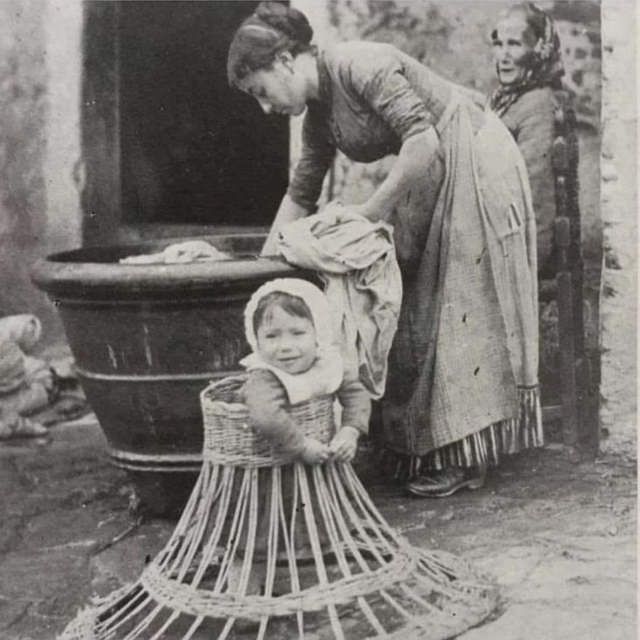
1910s photo of mother doing laundry while baby walks in a wicker frame.

I've now come full circle back to a mother and child, and shared most of the sepia photos that have come across my desk in the last week.

I hope you have a great weekend!

Today's quote:

To bear up under loss, to fight the bitterness of defeat and the weakness of grief, to be victor over anger, to smile when tears are close, to resist evil men and base instincts, to hate hate and to love love, to go on when it would seem good to die, to seek ever after the glory and the dream, to look up with unquenchable faith in something evermore about to be, that is what any man can do, and so be great. -Zane Grey, author (31 Jan 1872-1939)

Tomorrow's post will be about thinking outside the box and into a circle!