Update about blog

The joy of waking to this view each morning is just so wonderful. Even if the camera sees all the distortions from the window screen, I easily ignore them. Many of these green trees stand near or by the Animas River which flows through the town.
Showing posts with label Rachel Carson. Show all posts

Sunday, January 25, 2026

Eco-feminism - Maybe the Peacemakers - 2

Photo by Ann Cahill


BLESSING FOR PEACE
As the fever of day calms towards twilight
May all that is strained in us come to ease.
We pray for all who suffered violence today,
May an unexpected serenity surprise them.
For those who risk their lives each day for peace,
May their hearts glimpse providence at the heart of history.
That those who make riches from violence and war
Might hear in their dreams the cries of the lost.
That we might see through our fear of each other
A new vision to heal our fatal attraction to aggression.
That those who enjoy the privilege of peace
Might not forget their tormented brothers and sisters.
That the wolf might lie down with the lamb,
That our swords be beaten into ploughshares
And no hurt or harm be done
Anywhere along the holy mountain.
JOHN O'DONOHUE
From the book, Benedictus
County Clare, Ireland


Have you missed my not including goddess information in my last couple of blogs?

A repost of parts of a blog in 2015.

------------
The other evening some of us gathered to watch a relatively old video in the series "Goddess Remembered" (1989) created by Donna Read of Canadian Broadcasting.
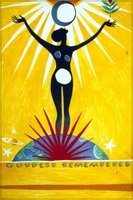

This documentary is a salute to 35,000 years of the goddess-worshipping religions of the ancient past. The film features Merlin Stone, Carol Christ, Starhawk, Luisah Teish and Jean Bolen; all of whom link the loss of goddess-centric societies with today's environmental crisis. This is the first part of a 3-part series that includes The Burning Times and Full Circle.

----------------------------

Now there's a movement called Eco-feminism.  As well as lots of other environmental groups with very positive momentum.  It's needed more than ever.


So what's with studying goddess cultures that existed so long ago, before the ones of today where we find the goddess in second place in a hierarchy of deities?  Name one religion today where goddesses are venerated either as primary or even equal to male deities.

They were egalitarian societies where women and men were equals.  Societies that lasted thousands of years without warfare.

How can archaeologists tell this?  They examined the ruins of cities without any defensive fortifications.  There are no weapons besides those used to hunt and prepare foods.  See Marija Gimbutus work for more information on this.

Just think.  Life without warfare at all.

Nobody who greets a stranger had to worry about evil intentions.  A time when Rumi's poems would truly mean you welcome all guests to your home, even without knowing who they are.

Imagine when the deities of these civilizations were female, as evident through thousands of figurines, carefully made and even placed in areas of the homes and cities suggesting rituals of some kind. There are very very few male oriented sculptures which were found.  This led the early male archaeologists who found all these female forms to think only of "fertility goddesses" and that ancient men perhaps had made them with the same intentions modern men have in looking at feminine beauty.

But my thoughts also bring me to wonder if any of the craftsmen were indeed women.


I'm thrilled about the concept that a culture where men and women had equality would mean that women would be equal to men...and men would be equal to women.  Nobody would be Top Dog.  Nobody would be Bottom Dog.

---------------------------------
It is so hard to express the concept of true equality across to a culture (today) where there is such hierarchical competition to be the winner, to prove something is better than something else, to elect only the one candidate, and then the 49% who lost don't have any representation.  We are submersed in a culture of inequality, and don't see it, just like the fish who has no concept of water until she's out of it.


-------------------------
Power "over" the earth is now the most important place where we need a new way of co-existing.  If we want to continue living on it, we need to recognize our symbiotic relationship with all life, the chemicals we create and discard, and how we can improve the earth rather than destroy it.
----------------

Winter Shadows, 2026 by Jeff Bourgeau.

-----------------


Today's Quote:


O Great Spirit, I awake to another sun, grateful for gifts bestowed, granted one by one.
Twylah Nitsch
Seneca Medicine Woman

Thursday, September 28, 2023

"Silent Spring" has it's birth anniversary

Here's what Writer's Almanac Newsletter published on Sept. 27, 2017. I think it should be memorialized as a holiday, when Silent Spring was published. What changed so much!


Rachel Carson’s groundbreaking book Silent Spring was published on this date in 1962.

 Carson was a marine biologist, but she was also a crafter of lyrical prose who contributed to magazines like The New Yorker and Atlantic Monthly, and who had already published three popular lyrical books about the sea. One of these — The Sea Around Us (1951) — had won the National Book Award. In the course of her work, Carson became aware of the ways that chemical pesticides were harming plants and wildlife. She felt it was important to make the public aware of this, but she was not an investigative journalist and didn’t feel confident enough to write what she called the “poison book.” She began trying to interest magazines in the subject as early as 1945. In 1958, Carson’s friend mentioned that she was finding a lot of dead birds in her Massachusetts bird sanctuary. Carson, in turn, wrote to E.B. White, who was an editor at The New Yorker. She suggested that White write an article about pesticides. He said the magazine would be keen to publish such an article, but he encouraged her to write it herself. The article became a multiyear project that Carson pursued through personal tragedies like the death of her mother, and her own diagnosis with breast cancer in 1960.

By 1962, many scientists had published work that questioned whether the widespread and indiscriminate use of pesticides like DDT was safe. Carson gathered these reports in one place, and then used her literary talents to bring the issue to vivid life. The New Yorker serialized Silent Spring in the summer of 1962, and it was published in book form in September. The title comes from one of the book’s chapters, in which Carson paints a picture of a future spring morning without birdsong. “No witchcraft,” Carson writes, “no enemy action had silenced the rebirth of new life in this stricken world. The people had done it themselves.”

The book was a huge best-seller, and although she was dreadfully ill from her cancer treatments, Carson appeared on many television shows to defend her research. Eric Sevareid, who interviewed Carson for CBS Reports, later said he was afraid she wouldn’t live long enough to see the broadcast of their interview. In June 1963, she appeared before a Senate subcommittee and gave policy recommendations that she had worked on for five years. She didn’t advocate a ban on all pesticides, but recommended that they be used more judiciously. Aerial spraying was the worst culprit, because it could end up on people’s private land without their knowledge or consent. “If the Bill of Rights contains no guarantee that a citizen shall be secure against lethal poisons distributed either by private individuals or by public officials, it is surely only because our forefathers, despite their considerable wisdom and foresight, could conceive of no such problem,” Carson said.

Chemical companies, backed by the U.S. Department of Agriculture, were not fans of the book. They tried to sue Carson, her publisher, and The New Yorker. They spent $250,000 on a smear campaign, calling her a “hysterical woman” and a communist, and casting doubt on her scientific bona fides. A former secretary of agriculture wondered publicly why a spinster with no children cared so much about genetics. But all the scandal only helped the book become a household name. President Kennedy read it with interest, and instructed his science advisors to look into Carson’s allegations against DDT. They determined that her claims held up, but it was still 10 years before the widespread use of DDT was banned in the United States. Carson still has her detractors today who say that the banning of DDT killed more people — due to malaria-carrying mosquitos — than Hitler.

Carson died of breast cancer in April 1964. She lived to see the book’s commercial success. She didn’t live to see the Clean Air Act, the Clean Water Act, the Occupational Safety and Health Act, or the Environmental Protection Agency — all of which came about due, in large part, to Silent Spring."


Photo by fellow blogger, Beyond the Fields We Know

And for those who like Playing for Change (as I certainly do) here's a beautifully done bluesy rendition with lots of beautiful scenery, as well as climate change effects.

John Paul Jones on "When the Levee Breaks


Monday, March 6, 2023

Rachel Carson - Women's History Month 6

 Born in 1907 in Springdale, PA, Rachel Carson grew up in the hills overlooking the Allegheny River, where she fell in love with nature after exploring the landscapes and wildlife on walks with her mother. And it was also there that she fell in love with writing, winning several awards in her youth. She would tell people her dream was to become a writer.

While her family was not well off, her mother insisted that Rachel attend college. Rachel entered intending to study English but changed her major to biology. After graduating, she earned a master's degree in zoology and then began a doctorate. But because of the Great Depression and with her father's passing in 1935, Rachel dropped out, taking a job with the U.S. Bureau of Fisheries to help support her family.
In addition to working in this job, Rachel began writing articles about environmental issues for publications. Those articles evolved into books. And in these works, which were beloved by many, she helped people better understand nature while courageously challenging practices that hurt people and the environment. These challenges had policy implications, leading to a national ban on DDT and other pesticides.


Many of us, including myself, consider her the mother of the environmental movement.

Today more than ever before, we must each individually decide what we can do to help keep our earth safe in which to live and thrive against the forces of climate change.

From the Marginalian:

“The real wealth of the Nation,” marine biologist and author Rachel Carson wrote in her courageous 1953 protest letter“lies in the resources of the earth — soil, water, forests, minerals, and wildlife… Their administration is not properly, and cannot be, a matter of politics.” Carson’s legacy inspired the creation of Earth Day and the founding of the Environmental Protection Agency, whose hard-won environmental regulations are now being undone in the hands of a heedless administration. Carson was a scientist who thought and wrote like a poet. As she catalyzed the modern environmental movement with her epoch-making 1962 book Silent Spring, she was emboldened by a line from a 1914 poem by Ella Wheeler Wilcox:

To sin by silence, when we should protest, makes cowards out of men.