Update about blog

photo from the internet
Showing posts with label Galveston TX. Show all posts

Monday, June 30, 2025

Monday murals and then some


Flowers at Art in Bloom 2025, Center for the Arts, Black Mountain NC


Some words of wisdom from Facebook.

Sunday last Helen and I went to a free art museum trip in Asheville. Zoom tickets are available to lots of venues in Asheville, through our Buncombe County libraries. This one was for an air conditioned trip, and a pass lets two people in. We also signed up for a Van Gogh movie, taken from an exhibit at another museum, complete with docents talking about the paintings. It was pricy, but after all, we'd obtained the entrance tickets for nothing.

Around noon thirty in downtown Asheville, there was a Vegan-Fest. Too hot to go strolling for me, however.

I had to enjoy this lady's body art, who checked us in at the front desk.


A wonderful mural in the lobby of the Asheville Art Museum


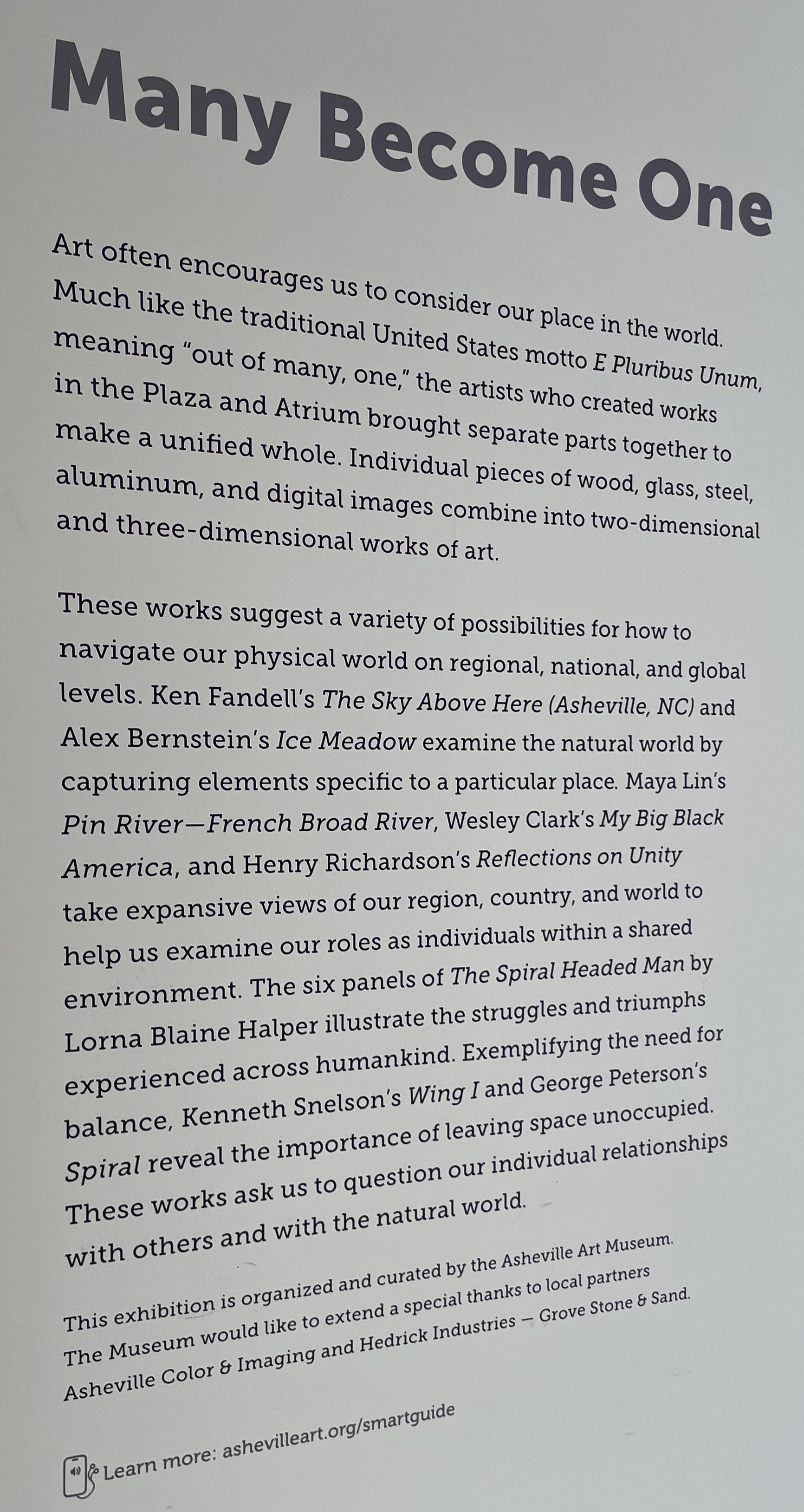
Layers of wood, cut into a Black America. (My son Tai Rogers would love this, as he made many white map-like sculptural forms.)

Detail of "My Big Black America"


Today's quote:

Life, what an exquisite privilege.

Katie Rubinstein

And an environmental quote from Katharine Hayhoe:

“it's OK to grieve over the things we've lost and will lose, grief isn't the same as despair. We need to be brave enough to do the right thing."

--------------------

Early coffee at Four Sisters Bakery (where we also found day-old croissants available!) with Suzanne, a dear old friend yesterday morning. Well, I got a decaf Americano, while she brought her own Chai tea. She's trying also to downsize things and finds it hard to do. We discussed briefly the need to get accurate news, and I referred her to BlueSky. She's an artist that has breast cancer, and has given away and sold a lot of her supplies...but still has a good easel for some aspiring talented person. Her interests are similar to mine in many ways. We plan to meet more Sunday mornings and sit in the cool fresh air and chat. She's interested in that Podcast about the Trickster, which I posted about on "Inner Workings" blog. And like my friend Teresa, she's enjoying doing "slow stitching."

-----------
We spoke highly of Thom Tillis (one of NC's Senators in Washington) who'd voted against the Big Ugly Budget Bill. And then later I saw he'd announced his not running for another election.

"After Trump attacked him yesterday for not supporting the budget reconciliation bill, Senator Thom Tillis (R-NC) has announced he will not run for reelection next year, indicating his unwillingness to face a primary challenger backed by Trump. This puts the seat in play for a Democratic pickup.

In a statement, Tillis said: “In Washington over the last few years, it’s become increasingly evident that leaders who are willing to embrace bipartisanship, compromise, and demonstrate independent thinking are becoming an endangered species.” He wrote: “I look forward to having the pure freedom to call the balls and strikes as I see fit and representing the great people of North Carolina to the best of my ability.” 

Tonight, Tillis told the Senate: “What do I tell 663,000 people in two years or three years, when President Trump breaks his promise by pushing them off of Medicaid because the funding’s not there anymore, guys?... [T]he effect of this bill is to break a promise.”

The nonpartisan Congressional Budget Office today said the tax cuts in the budget reconciliation bill the Republican senators are trying to pass will increase the national debt by $3.3 trillion over the next ten years despite the $1.2 trillion in cuts to Medicaid, Supplemental Nutrition Assistance Program, the National Institutes of Health, the Centers for Disease Control and Prevention, and other programs over the same period. Senator Raphael Warnock (D-GA) called the measure “Robin Hood in reverse…stealing from the poor in order to give to the rich, this massive transfer of wealth from the bottom to the top…. This is socialism for the rich.” 

Heather Cox Richardson 


Daylilies at Four Sisters Bakery


---------------------
My Old Photos:


4.21.48 Galveston TX, my father, George Rogers Jr, grandmother, Ada Rogers & Uncle Chauncey Rogers, myself, Barbara & little sister, Mary Beth. Mother was the photographer. We called it soapy water!

Saturday, June 22, 2024

My family from Galveston TX and the beach

 The beach I'm most familiar with is in Galveston TX.

(From a post in 2013...)

My father was born there in 1914.
His father, George Elmore Rogers, Sr., built the house my father was born in, and they lived there many years. (See george-elmore-rogers-sr HERE)

House built by George Rogers Sr. in Galveston, TX

My grandfather's mother, Bettie Bass Rogers, lived in Galveston the later part of her life (from before the storm of 1900 till her death in 1924).  (I featured my family survivors of the Storm of 1900 HERE)

My father's mother, Ada Phillips Swasey Rogers, was raised in Galveston. Here's a quick summary of her family who lived there as well.

Her mother, Zulieka Phillips Swasey had been raised as an orphan living with her mother's sisters in Galveston during and following the Civil War. (See this blog posting on Zulieka Phillips Swasey's birthday.)  Zulieka and Ada Phillips were brought up in their aunts' homes, probably that of  Elizabeth Pulsifer Granger Sweet or with their other aunt, Lucy Ellen Granger Wakeley.  I have some letters written in the household by children, which don't describe clearly who was where.
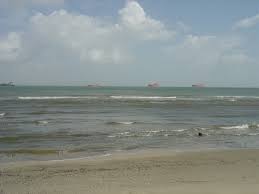


But what of the time when Galveston was the largest city in Texas?  My family first came there before the Civil War. 

The Handbook of Texas History (see below) talks about an epidemic of Yellow Fever in 1867, affecting three fourths of the population.  "Galveston nonetheless surged ahead and ranked as the largest Texas city in 1870 with 13,818 people and also in 1880 with 22,248 people."

Incidentally I can't find anyone in my family tree who died in 1867.  But of the relatives living in Galveston at that time, there are a lot who don't even have a date of their death.  That has little meaning, but the conjecture is that if 20 people died in a day, (see below) it was probably difficult to keep track of who they were.

Also many people would pass through an international port from far across the oceans.  Many of the German settlers in Texas came through Galveston.  So my mother's grandfather's guardians might have walked the streets around 1870 as they first learned English before going towards Hillsboro, Texas. I have no idea who brought my great grandfather from Germany to Texas, nor even the ship he arrived on nor the year.
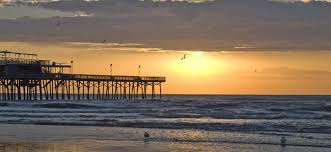


Source:
Handbook of Texas History online 

GALVESTON, TEXAS. The city of Galveston is on Galveston Island two miles offshore in the Gulf of Mexico, at 29°18' north latitude and 94°47' west longitude, in Galveston County. It is fifty miles from Houston and is the southern terminal point of Interstate Highway 45. The island is a part of the string of sand barrier islands along the coastal zone of Texas. On its eastern end where the city stands the currents of Galveston Bay maintain a natural harbor which historically provided the best port site between New Orleans and Veracruz.

 Karankawa Indians used the island for hunting and fishing, and it was the probable location of the shipwreck landing of Alvar Núñez Cabeza de Vaca in 1528. José de Eviaqv, who charted the Texas coast in 1785, named Galveston Bay in honor of Bernardo de Gálvez, the viceroy of Mexico. Later mapmakers applied the name Galveston to the island. Louis Aury established a naval base at the harbor in 1816 to support the revolution in Mexico, and from this point Aury, Francisco Xavier Mina, and Henry Perry launched an unsuccessful attack against the Spanish in Mexico.

When Aury returned with his ships after leaving Perry and Mina on the Mexican coast he found Galveston occupied by Jean Laffite, who had set up a pirate camp called Campeachy to dispose of contraband and provide supplies for the freebooters. In 1821, however, the United States forced Laffite to evacuate.

Mexico designated Galveston a port of entry in 1825 and established a small customshouse in 1830. During the Texas Revolution the harbor served as the port for the Texas Navy and the last point of retreat of the Texas government. Following the war Michel B. Menard and a group of investors obtained ownership of 4,605 acres at the harbor to found a town. After platting the land in gridiron fashion and adopting the name Galveston, Menard and his associates began selling town lots on April 20, 1838. The following year the Texas legislature granted incorporation to the city of Galveston with the power to elect town officers.

Galveston grew on the strength of the port; cotton moved outward, and farming supplies and immigrants came in. The city served as a transfer point for oceangoing vessels and coastal steamers which ran a route through Galveston Bay and Buffalo Bayou to Houston. The construction of the Galveston, Houston and Henderson Railroad, which built a bridge to the island in 1860, strengthened the link between the two towns.

Business collapsed, however, when the Civil War brought a blockade of the port by Union ships and a brief occupation of the town by federal troops. The dramatic battle of Galveston on New Year's Day, 1863, ended the occupation, but the port remained isolated and served mainly as a departure point for small blockade runners. Following the war Galveston quickly recovered; northern troops were stationed in the city, and a depleted state demanded the trade goods denied by the blockade and the war effort.

With so many susceptible people present, however, the city in 1867 suffered one of its worst onslaughts of yellow fever, which affected about three-fourths of the population and killed at a rate of twenty per day. This disease, a malady of most southern ports, did not cease to be a threat until the institution of rigid quarantines after 1873.

Galveston nonetheless surged ahead and ranked as the largest Texas city in 1870 with 13,818 people and also in 1880 with 22,248 people. It had the first structure to use electric lighting, the Galveston Pavilion; the first telephone; and the first baseball game in the state. The Galveston News, founded in 1842, is the state's oldest continuing daily newspaper. The Galveston buildings, especially those designed by architect Nicholas J. Clayton, were among the finest of the time; in 1881 the city won the site of the state medical school in a statewide election; and the Grand Opera House was built in 1894 and presented the best theatrical productions in Texas. The opera house was restored as a modern performing arts hall in the 1980s.
In spite of efforts to maintain trade supremacy by improving port facilities and contributing to the construction of railways running to the city, Galveston business leaders saw their town slip to fourth place in population by 1900. Galveston acquired a coast guard station in 1897 which still operated in the 1990s and a small military base, Fort Crockett (1897–1957), but other cities such as Dallas acquired transcontinental rail connections and a growth in manufacturing establishments. At a time when Houston, Beaumont, and Port Arthur benefitted from the oil discoveries of the early twentieth century, Galveston had to put its energy into a recovery from the nation's worst natural disaster, the Galveston hurricane of 1900. The island lay in the pathway of hurricanes coursing across the Gulf of Mexico and suffered at least eleven times in the nineteenth century. The Galveston hurricane of 1900, with wind gusts of 120 miles per hour, flooded the city, battered homes and buildings with floating debris, and killed an estimated 6,000 people in the city. Another 4,000 to 6,000 people died on the nearby coast. For future protection the city and county constructed a seventeen-foot seawall on the Gulf side of the island, raised the grade level, and built an all-weather bridge to the mainland. The development of other ports by means of the ship channels, alternative sites for business and manufacturing provided by other modes of transportation, and notoriety because of hurricanes destined the island city to medium size. In 1980 it had a population of 61,902 and ranked twenty-ninth in the state.

Around 1900 business leaders redesigned the city government into the first commission form in the country (see COMMISSION FORM OF CITY GOVERNMENT). Their idea was to have the governor of the state appoint a mayor and four commissioners. Each commissioner would control a specific function of government-finance, police and fire control, water and sewage, streets and public improvements. Since the original plan was patently undemocratic, it was subsequently revised to provide for the election of the officers. The commission plan was somewhat popular in the years before World War I but faded in the 1920s in favor of the city-manager plan. Galveston, however, continued with the commission government until 1960, when it too changed to a city-manager form.
During the years between the world wars Galveston, under the influence of Sam and Rosario (Rose) Maceo, exploited the prohibition of liquor and gambling by offering illegal drinks and betting in nightclubs and saloons. This, combined with the extensive prostitution which had existed in the port city since the Civil War, made Galveston the sin city of the Gulf. The citizens tolerated and supported the illegal activities and took pride in being "the free state of Galveston." In 1957, however, Attorney General Will Wilson with the help of Texas Rangersqv shut down bars such as the famous Ballinese Room, destroyed gambling equipment, and closed many houses of prostitution. Between 1985 and 1988 Galveston voters in nonbinding referenda defeated proposals to legalize casino gambling, although proponents argued that gambling could promote the local economy. Pursuant to a law enacted by the Texas legislature, however, gambling on board cruise ships embarking from Galveston was expected to boost business activity in the wharf district beginning in September 1989.

Galveston has survived on its port, tourism, and the University of Texas Medical Branchqv. In the later 1900s the Galveston Historical Foundation encouraged historic preservation in the old business area of the Strand and various Victorian homes, which has added to the visitor attractions of the city. The famous Rosenberg Library serves as a circulating library as well as an important repository for archival materials pertaining to the history of Galveston and Texas. The restoration of the nineteenth-century square-rigged vessel, Elissa, in 1975–82 gave Texans their own "Tall Ship" to sail into New York harbor for the celebration of the centennial of the Statue of Liberty. In 2000 the population was 57,247.

BIBLIOGRAPHY: 
Howard Barnstone, The Galveston That Was (New York: Macmillan, 1966). Charles Waldo Hayes, Galveston: History of the Island and the City (2 vols., Austin: Jenkins Garrett, 1974). David G. McComb, Galveston: A History (Austin: University of Texas Press, 1986).

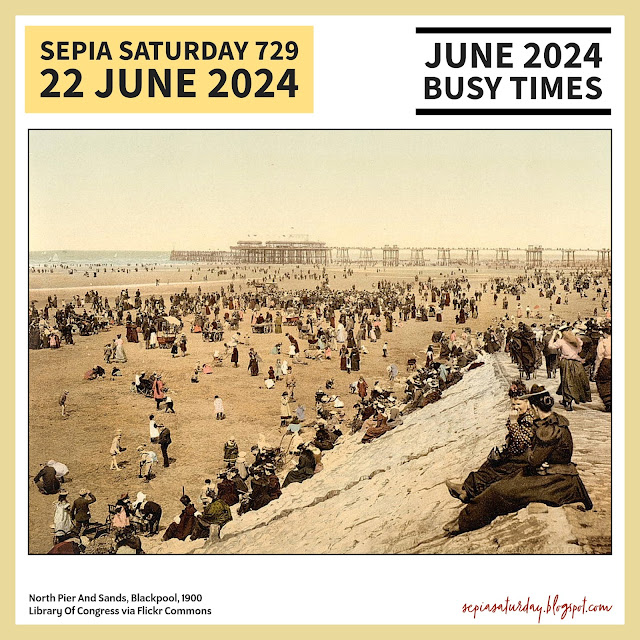
Galveston beach with seawall, about 1915


Sharing with Sepia Saturday this week.

Today's quote:

Flowers unfold slowly and gently, bit by bit in the sunshine, and a soul too must never be punished or driven, but unfolds in its own perfect timing to reveal its true wonder and beauty.
            - "
The Findhorn Garden," The Findhorn Community

Sunday, February 1, 2015

Galveston history - part 2

Galveston (mid 19th Century) served as a transfer point for oceangoing vessels and coastal steamers which ran a route through Galveston Bay and Buffalo Bayou to Houston.
Galveston 1871
The island has sometimes been called the "Ellis Island of the West" as it was the primary point of entry for European immigrants settling in the western United States. German immigration during this period was so great that the German language became a commonly used language on the city's streets. The immigrants were not simply the poor or the oppressed seeking refuge but many of the educated, middle class.
The Galveston Weekly News described one 1849 ship's arrival as carrying members of the "wealthy class" including lawyers and merchants and many skilled workers.


Beach Hotel catered to vacationers until a fire in 1898.


Between 1838 and 1842, 18 newspapers were started to serve the island's rapidly growing population (The Galveston County Daily News is the sole survivor). A causeway linking the island with the mainland was finished in 1860, which paved the way for railroad expansion.

In 1843 Henry Rosenberg (friend of my great Uncle Chauncy Sweet) settled in Galveston from Switzerland.  I shared about his contributions to the city HERE.

Chauncy Sweet Friend Henry Rosenberg in 1893


The construction of the Galveston, Houston and Henderson Railroad, which built a bridge to the island in 1860, strengthened the link between the two towns.
Tensions over slavery in the U.S. as a whole eventually led to the American Civil War, [April 12, 1861 to April 9, 1865], in which Texas joined on the side of the Confederacy. The Battle of Galveston was fought in Galveston Bay and island on January 1, 1863, when Confederate forces under Major General John B. Magruder attacked and expelled occupying Union troops from the city, which remained in Confederate hands for the duration of the war.
Juneteenth, which is the oldest nationally celebrated commemoration of the ending of slavery in the United States, owes its origins to the announcement of the Emancipation Proclamation upon the return of Union forces to Galveston in 1865.
My ancestor, George T. Granger (Lucy's husband) wrote at the beginning of the Civil War in Dec. 1861 of the death of their daughter, Mary Phillips, HERE for letter and transcription.

During the Civil War, orphans Zulieka and Ada Phillips were taken in by the Granger family, either with Lucy Pulsifer Granger, their grandmother, or with Aunts Lucy Granger Wakelee or Lizzie (Elizabeth) Granger Sweet.  I am a descendent of Zulieka.  I wrote in my blog about their mother's letters to her sisters prior to the outbreak of the war HERE transcriptions of more of Mary Phillips letters.
Following the war Galveston quickly recovered; northern troops were stationed in the city, and a depleted state demanded the trade goods denied by the blockade and the war effort. With so many susceptible people present, however, the city in 1867 suffered one of its worst onslaughts of yellow fever, which affected about three-fourths of the population and killed at a rate of twenty per day. This disease, a malady of most southern ports, did not cease to be a threat until the institution of rigid quarantines after 1873. Galveston nonetheless surged ahead and ranked as the largest Texas city in 1870 with 13,818 people and also in 1880 with 22,248 people.
In spite of efforts to maintain trade supremacy by improving port facilities and contributing to the construction of railways running to the city, Galveston business leaders saw their town slip to fourth place in population by 1900. Galveston acquired a coast guard station in 1897 which still operated in the 1990s and a small military base, Fort Crockett (1897–1957), but other cities such as Dallas acquired transcontinental rail connections and a growth in manufacturing establishments. At a time when Houston, Beaumont, and Port Arthur benefitted from the oil discoveries of the early twentieth century, Galveston had to put its energy into a recovery from the nation's worst natural disaster, the Galveston hurricane of 1900. The island lay in the pathway of hurricanes coursing across the Gulf of Mexico and suffered at least eleven times in the nineteenth century.
I mentioned Elizabeth Granger Sweet, "Grand Aunt" to my relatives, who survived the hurricane of 1900, HERE.

And my own grandfather, George Rogers, Sr. also was a survivor of that hurricane, who I honored in this post which includes details and pictures.
 
The Galveston hurricane of 1900, with wind gusts of 120 miles per hour, flooded the city, battered homes and buildings with floating debris, and killed an estimated 6,000 people in the city. Another 4,000 to 6,000 people died on the nearby coast. For future protection the city and county constructed a seventeen-foot seawall on the Gulf side of the island, raised the grade level, and built an all-weather bridge to the mainland. The development of other ports by means of the ship channels, alternative sites for business and manufacturing provided by other modes of transportation, and notoriety because of hurricanes destined the island city to medium size.
 My grandmother, Ada Swasey Rogers, also survived the storm, and in 1906 married my grandfather.
I gave a lot of the same information about Galveston a couple of years ago on this blog HERE.


Rogers house, built by my grandfather and where my father was born in 1914.


Busy Dock Scene, Galveston, ca. 1912.
The Galveston–Houston Electric Railway was established in 1911 and ran between the city and Houston. The railway was recognized as the fastest interurban line in 1925 and 1926.
More recent times:
During the years between the world wars Galveston, under the influence of Sam and Rosario (Rose) Maceo, exploited the prohibition of liquor and gambling by offering illegal drinks and betting in nightclubs and saloons. This, combined with the extensive prostitution which had existed in the port city since the Civil War, made Galveston the sin city of the Gulf. The citizens tolerated and supported the illegal activities and took pride in being "the free state of Galveston." In 1957, however, Attorney General Will Wilson with the help of Texas Rangers shut down bars such as the famous Ballinese Room, destroyed gambling equipment, and closed many houses of prostitution. 
BIBLIOGRAPHY: 
Howard Barnstone, The Galveston That Was (New York: Macmillan, 1966). Charles Waldo Hayes, Galveston: History of the Island and the City (2 vols., Austin: Jenkins Garrett, 1974). David G. McComb, Galveston: A History (Austin: University of Texas Press, 1986).

My grandparents had moved from Galveston to Fort Worth TX by 1920.


Postcard view of Beach Boulevard, early 1940s
Wikipedia continues with the changes since they left:
Beginning in 1957, the Galveston Historical Foundation began its efforts to preserve historic buildings.[58] The 1966 book The Galveston That Was helped encourage the preservation movement. A new, family-oriented tourism emerged in the city over many years.The 1960s saw the expansion of higher education in Galveston.
Historic "Strand District" of Galveston
In the 2000s, property values rose after expensive projects were completed and demand for second homes,[which] led some middle class families to move from Galveston to other areas.
In 2007 The Associated Press compiled a list of the most vulnerable places to hurricanes in the U.S. and Galveston was one of five areas named. Among the reasons cited were low elevation and the single evacuation route off the island which is blocked by the fourth largest city in the United States, Houston 
Hurricane Ike made landfall on Galveston Island in the early morning of September 13, 2008 as a Category 2 hurricane with winds of 110 miles per hour (180 km/h). Ike produced waves and a rising storm surge of about 14 feet (4.3 m), which went around the famous Galveston Seawall, flooding the city via the storm sewers, and the unprotected "bay side" of the island, before the first winds or drop of rain. The storm left Galveston without electricity, gas, water pressure and basic communications.
Handbook of Texas History online 
and Wikipedia provided facts.


 The city will continue, though it may have changes again.  But the bones of my ancestors are buried in the cemeteries of Galveston.


Friday, January 30, 2015

Galveston History - part 1

I want to share a bit of background on this city, where my paternal roots were planted for many years.

The Swaseys, the Grangers, the Phillips, the Gainers, and the Rogers came to that city when it was a booming attraction on the Gulf Coast of Texas.

Geographically, "the city of Galveston is on Galveston Island two miles offshore in the Gulf of Mexico, at 29°18' north latitude and 94°47' west longitude, in Galveston County. It is fifty miles from Houston . On its eastern end where the city stands, the currents of Galveston Bay maintain a natural harbor which historically provided the best port site between New Orleans and Veracruz. 

Texas History Online tells us: "Karankawa Indians used the island for hunting and fishing, and it was the probable location of the shipwreck landing of Alvar Núñez Cabeza de Vaca in 1528. José de Evia, who charted the Texas coast in 1785, named Galveston Bay in honor of Bernardo de Gálvez, the viceroy of Mexico. Later mapmakers applied the name Galveston to the island.

Wikipedia continues the history thus:
The first permanent European settlements on the island were constructed around 1816 by the pirate Louis-Michel Aury as a base of operations to support Mexico's rebellion against Spain. In 1817, Aury returned from an unsuccessful raid against Spain [for Mexican independence] to find the island occupied by the pirate Jean Lafitte, who took up residence there after having been driven from his stronghold in Barataria Bay off the coast of New Orleans, Louisiana. Lafitte organized the island's settlement into a pirate "kingdom" he called "Campeche", anointing himself the "head of government." Lafitte remained at Campeche until 1821 when he and his raiders were given an ultimatum by the United States Navy: leave or be destroyed. Lafitte burned his settlement to the ground and sailed under cover of night for parts unknown.

[Remember Texas belonged to Mexico until 1836.]


Following its successful revolution from Spain, the Congress of Mexico issued a proclamation on October 17, 1825, establishing the Port of Galveston, and in 1830 erected a customs house. During the Texas Revolution, Galveston served as the main port for the Texas Navy. Galveston also served as the capital of the Republic of Texas when in 1836 interim president David G. Burnet relocated his government there. In 1836, Michel Branamour Menard, a native of Canada, along with several associates purchased 4,605 acres (18.64 km2) of land for $50,000 from the Austin Colony to found the town that would become the modern city of Galveston. Menard and his associates began selling plots on April 20, 1838. In 1839, the City of Galveston adopted a charter and was incorporated by the Congress of the Republic of Texas.
During the mid-19th century, Galveston emerged as an international city with immigration and trade from around the U.S. and the world. The city became one of the nation's busiest ports and the world's leading port for cotton exports. Galveston became Texas' largest city and, during that era, was its prime commercial center.
 Wikipedia lists:
  During this golden era of Galveston's history, the city was home to a number of state firsts that include the first post office (1836), the first naval base (1836), the first Texas chapter of a Masonic order (1840); the first cotton compress (1842), the first parochial school (Ursuline Academy) (1847), the first insurance company (1854), the first gas lights (1856), first Roman Catholic hospital (St. Mary's Hospital) (1866), first Jewish Reform Congregation (Congregation B'nai Israel) (1868), the first opera house (1870), the first orphanage (1876), the first telephone (1878), the first electric lights (1883), the first medical college (now the University of Texas Medical Branch) (1891), and the first school for nurses (1890).

Honoring my ancestor Lucy Pulsifer Granger for the next two days...then I'll return to more Galveston information.