Update about blogCa

I-40 picked up the old Rte. 66 somewhere along the way, maybe Little Rock, maybe Oklahoma City. But it is the 100th anniversary of Rte 66 so I enjoyed thinking about my parents driving on part Of it in. St. Louis at least. Here we continued from Santa Rosita to Gallup NM, then left both highways to go north to CO.
Showing posts with label Suffolk VA. Show all posts

Friday, August 8, 2014

National recognition of our tribe?

More news articles from earlier in 2014 about the Native American tribe of Nansemonds, from whom my Rogers family has descended through my great great grandfather, Col. Richard Bass. I started a year ago HERE, and several following posts are about my Native American connection.

This post also will talk about false pretenses..


Bill to recognize Nansemonds passes committee

Published 9:14pm Wednesday, April 2, 2014

A bill that would extend federal recognition to the Nansemond Indian Tribe and five others in Virginia passed the (US) Senate Indian Affairs Committee on Wednesday.

The tribes also include the Chickahominy, Eastern Chickahominy, Upper Mattaponi, Rappahannock and Monacan.

“I just hope we can finally get there,” Nansemond Indian Tribal Association Chief Barry Bass said on Thursday. “It’s been a long, hard road.”

The bill has passed the Senate Indian Affairs Committee before, but a vote in the full Senate has been blocked by senators who believe the tribes should have to go through the Bureau of Indian Affairs as other tribes have done.

But recognition through the bureau’s administrative process requires documentation that current tribal members have a continuous line of descent from the historical tribes. That has been difficult, if not impossible, for Virginia Indians to prove, in part because of Walter Plecker, who was the registrar of Virginia’s Bureau of Vital Statistics from 1912 to 1946. He replaced “Indian” with “black” for the race on many birth and death certificates that passed through his office, ensuring that no official documentation exists for many tribal members to prove their relationship to ancestors.

“Federal recognition of the Chickahominy, Eastern Chickahominy, Monacan, Nansemond, Rappahannock and Upper Mattaponi tribes of Virginia is long overdue,” Sen. Mark Warner said in a press release. “Members of our Virginia Indian tribes are both part of the history of the Commonwealth and valued members of our present and should be recognized as such.”

“Committee passage of this legislation is a critical step toward granting these six Virginia tribes the recognition they deserve,” Sen. Tim Kaine said in the press release. “These tribes are an integral part of Virginia’s history and identity, and it is both troubling and tragic that they have never been recognized by the United States, even when more than 500 other Indian tribes have been granted recognition.”

NansemondLogo Keziash Elizabeth Tucker Bass

Time for recognition

Published 9:58pm Friday, April 4, 2014


...Virginia has officially recognized Virginia’s Indian tribes, but the U.S. Senate has a chance now to finally make amends with them for Pleckerism. (see above)  Recognition of the tribes in Virginia — the first people Europeans encountered upon reaching the New World and the first people to call this place home — would help restore the identity that a truly hateful and bigoted man began tearing from them a century ago (Walter Plecker)
 Federal recognition would send a message that the nation is also proud of these First Peoples, their heritage and the important place they hold in Virginia’s — and the nation’s — history.

Source: http://www.suffolknewsherald.com/2014/04/04/time-for-recognition-3/
(underlines and bold typeface by BRogers)


I'm submitting this post to Sepia Saturday this week, where the topic does include false pretenses (which is this man's charged offense).  


I'd say Pleckerism definitely qualifies, and certainly was criminal, even unto the seventh (How many?) generations that follow and aren't recognized as American Indians.

...............................................................................................................

I personally find it interesting that still, if a persons parents are white and black, they automatically become black on various pieces of paper.  If American Indian and white, they become American Indian, and if American Indian and black, Pleckerism continues and they are usually considered black.

You don't have to wear a white hood and burn crosses to continue white supremicism. Racism is still an ugly truth in our lives today.  I live in the south still.  

I wonder how things are in the UK and Australia?

Tuesday, August 5, 2014

Mattanock Town

Let's spend a moment or two catching up (perhaps) with the events and connections which I found about a year ago.  The Rogers family, through my great-great grandfather, Col Richard Bass, are descendents of the Nansemond Indians of Virginia, who are currently located in Suffolk, VA.  The tribe has a bit of a problem being recognized by US Congress...still.

But here are some articles the Suffolk News Herald has published in the last year.  I'll limit each day to one topic.


Surrounded by city officials, Nansemond Indian Tribe Chief Barry Bass signs a ceremonial document at the Aug. 17 2013 powwow.

Home again

Published 8:49pm Wednesday, September 25, 2013A step forward. A swoop of the pen. And just like that, the Nansemond Indian Tribe had its land back.
Except it didn’t happen just like that. European settlers forced the tribe off its land in the early 1600s, and the tribe didn’t start the process of trying to get it back until nearly 400 years later.
Once they started, there were planning meetings. City Council meetings. Unsuccessful votes, and more meetings.
Finally, the vote came. 7-1, but it was enough. The tribe had its ancestral land back.
Then came more meetings, lawyers, more votes. It was a long road to Aug. 17, 2013, when at the end of Pembroke Lane, under a tent, Chief Barry Bass stepped forward along with city leaders to sign his name to a ceremonial document. The actual deed had been recorded in the courthouse two days before.
Gifts were exchanged, here on this ground where hesitant contacts with European settlers resulted sometimes in gift exchanges, sometimes in death.
A monument was unveiled, here on this ground where the tribe’s ancestors once built their longhouses and kept gardens.
A celebratory powwow began, here on this ground where the tribe’s ancestors danced and drummed so long ago.
The mayor and the chief walked into the dance circle side by side, here on this ground where America’s long history of racial hostility began.
Soon the tribe hopes to change the land, which has been a city park for many years, into a development called Mattanock Town, named for its village that was near the site.
Here on this land, there will be longhouses once again. Gardens once again. Tribal crafts once again. A native burial ground once again.
Here on this land, Americans will learn rather than kill. Teach rather than conquer. Contribute rather than steal. Help build rather than burn down.
And the Nansemond Indian Tribe will once again have its own village.
http://www.suffolknewsherald.com/2013/09/25/home-again/ 

Wednesday, August 14, 2013

From Powhatan to Chief Bass

More on the Bass family...at least those who have been recognized as Nansemond Native Americans.

My connection is through Elizabeth "Bettie" Bass, my grandfather's mother. 
Here's a picture of one of the recent Chiefs of the Nansemond Nation.

And another picture of Chief Earl Bass (1910-1996) ...


A bit more deatils of  the stories...

Our Stories by Paul Clancy

My Columns in The Virginian-Pilot

August 22, 2010

One of these days I’m going to Suffolk’s historic area. Easy, you say? Well, not the way I’m traveling.

Like those who visited the town in centuries past, I’ll go by water. And that’s not so simple. It must be 15 miles along the wide, then narrow and twisty, Nansemond River. The charts show a high-voltage power line just past Dumpling Island with a 40-foot clearance. And then, just short of town, the 35-foot Rte. 58 bridge. OK for most power boats, but I’m going to have to anchor near the island and putt-putt the rest of the way to town.

But it’s worth it. This place is afloat in history.
I’ll take note, for starters, that Dumpling Island is where the Nansemond Indians had their sacred place – before it was ruined by those heavy handed colonials. John Smith tried to set up an outpost there but sent an oaf named John Martin to run it. Martin attacked the Indians, looted and burned their houses and temples, despoiled their dead and seized their corn. The Nansemonds retaliated and drove the white men back to Jamestown, but later, after bloody but failed uprisings, the tribe was driven from its ancestral lands.

During the long slog up the river, I’ll no doubt curse the day in 1742 that the colonial legislature created the town about as far upriver as you can go. Why not a little settlement at Reid’s Ferry where the first church of the Upper Parish of Nansemond had been built? Or the land where the politically connected Richard Bennett held a couple thousand acres? Originally, when the Jamestown folk decreed that there should be ports, Nansemond Town was created at the point where Bennett’s Creek joins the river. It didn’t last.

What did last was the place where John Constant, possibly from Hampshire, England, built a wharf and warehouse around 1720. From there, he exported tobacco, grains and salt on ships bound for Europe. It would have taken, I’m guessing, at least a couple of tide cycles for the ships to both gain and quit Constant’s Wharf.

Suffolk historian Kermit Hobbs says he thinks the location worked because it was close to the farmers who brought their produce to market, and close to the Great Dismal Swamp where timber was turned into shingles.

The little settlement prospered and in 1742 became a town, but the name was changed from Constant’s Wharf to Suffolk in honor of Gov. William Gooch’s home county in England.

It seems that someone opened the floodgates to history when Suffolk was created, bringing the Revolutionary War and the Civil War to its doorstep. British troops marched into town in May 1779 and turned it into an inferno as combustible material in waterfront warehouses ignited. Eighty years or so later, Union forces rode into town, set up headquarters at the extravagant Riddick’s Folly mansion and endured a year-long siege that ended when the Confederates marched off to Gettysburg.

Railroads from just about every point in Virginia made Suffolk a major hub. The Seaboard Station Railroad Museum has an intricate model train setup that shows the old town.

It all started with John Constant. His plantation, called Constantia, survived both wars but was eventually crowded out by Cedar Hill Cemetery. There’s a replica of the house, I’m told, on West Washington Street.

What has survived is Constant’s Wharf Public Park and Marina, a new centerpiece for the city, next to the Hilton Garden Inn. Hmm, I could cruise up to the marina of a summer evening, take in a TGIF concert at the park, dine at one of the town’s trendy restaurants, take in a play at the Suffolk Center for Cultural Arts, and then, since there’s no place to sleep in a dinghy, rough it at the Hilton.

In May 1863, Harper’s Weekly published this illustration of Constant’s Wharf in Civil War-era Suffolk.


Keziah Dennis, c.1899
Pamunkey Tribe
Smithsonian Institution #888

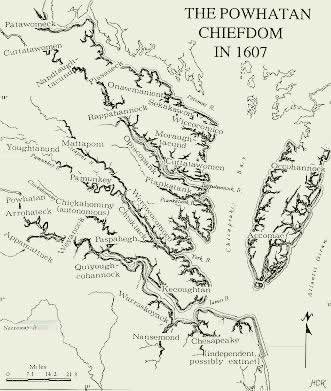
 The Chiefdom of Powhatan, 1607 with the Nansemond tribal area in center bottom of map