Update about blog

August 8th sunset over Hogback Ridge and Heron Peak. Durango CO with air quality warnings of "ozone" or possibly smoke from wildfires. I kept the windows closed.

Monday, January 5, 2015

On Newbury MA and Newburyport MA

This is information about an area where my ancestors, as well as those for my husband's family settled and raised their families.  My ancestors were among the ship builders, as well as hat makers, and I've even heard were tanners.

Below are some other trades that were pursued in early Massachusetts. (Info from Newbury MA and Essex County MA web site)
The settlers of Newbury were much like those of much of what is now northern Essex county. They were not religious enthusiasts or pilgrims who fled from religious persecution in England. They were substantial, law abiding, loyal English tradesmen, of that staunch middle class that was the backbone of England.
Those that settled Newbury came at different times and on different ships, between the end of April, 1634 and July, 1635. In one of the first ships arriving in 1635, came Thomas Parker a minister along with a small company of settlers. They went first to Agawam (Ipswich) and later along with their countrymen, who came from Wiltshire, England, to Newbury.
On May 6, 1635, before the settlers had moved from Ipswich to Newbury, the House of Deputies passed a resolution that Quascacunquen was to be established as a plantation and its name was to be changed to Newbury. So Newbury was named before the first settlers arrived, interestingly Thomas Parker had taught school in Newbury, Berkshire, England before coming to America.

The first settlers came by water from Ipswich, through Plum Island Sound, and up the Quascacunquen River, which was later renamed the Parker River. There had been a few fisherman occupying the banks of the Merrimack and Parker rivers before this, but they were not permanent settlers. These settlers came to Newbury in May or June of 1635. Ships from England began to arrive almost immediately with cattle and more settlers. Governor Winthrop, in his history of New England under the date of June 3, 1635, records the arrival of two ships with Dutch cattle along with the ship "James", from Southampton bringing more settlers.

Newbury was, therefore, begun as a stock raising enterprise and the settlers came to engage in that business and to establish homes for themselves. In total fifteen ships came in June and one each in August, November and December bringing still more families to the settlement.
 

There is no record of how many families arrived in the first year. Houses were erected on both sides of the Parker River. The principal settlement was around the meeting house on the lower green. The first church in Newbury could not have been formed before June, as some of those recorded at its formation are not recorded as having arrived until June.
In the division of land the first settlers recognized the scripture rule, "to him that hath shall be given," and the wealth of each grantee can be estimated by the number of acres given him.

The reason for establishing Newbury, as stated above, was not in fleeing from religious persecution but to utilize vacant lands and to establish a profitable business for the members of a stock-raising company.


When they arrived in Massachusetts, the settlers found that the state had established the Congregational form of religion. Everyone was taxed to support the Congregational Society and was commanded to attend worship at the meeting house. The Reverend Thomas Parker was a member of the stock raising company and was also the minister of the settlers.
The outlying settlers had a long journey to the meeting house. The congregations were in danger of attacks from Indians and wild beasts on their way to and from worship. There was a constant dread of attack during the time of services and all able bodied inhabitants were required to bring their weapons to church. Sentinels were posted at the doors.
In spite of the hardship and danger, the population steadily increased in number and gradually improved its worldly condition. Being cramped for room, the settlers moved up to the upper or training green. This was in order to get tillable land and engage in commercial pursuits. This movement began in 1642. Each had been allotted half an acre for a building lot on the lower green, on the upper green each was to have four acres for a house lot. Also on the upper green a new pond was artificially formed for watering cattle.
The new town gradually extended along the Merrimack River to the mouth of the Artichoke River. It appears that all desirable land in this region was apportioned among the freeholders by October 1646. The land beyond was ordered to lie perpetually common. This tract of common land was a part of Newbury and what is now West Newbury. The Indian threat had disappeared as most of the Indians in the region had been exterminated by an epidemic. The first record of an Indian living in Newbury is in January 1644, when a lot was granted to "John Indian."
Over the following years some notable, though not earth shaking events occurred in Newbury.
In 1639, Edward Rawson began the manufacture of gun powder in what was probably America's first powder mill.
Newbury had a trial for witchcraft thirteen years before the trials in Salem. In 1679, Elizabeth Morse was accused. She was condemned three times to die, but was reprieved and spent her last years in her home, at what is now Market square in Newburyport.
The first American born silversmith was Jeremiah Dummer of Newbury who apprenticed to John Hull, an Englishman. He practiced his trade in what is now Newburyport. Jeremiah was the father of Governor William Dummer the founder of Gov. Dummer Academy. Jeremiah's brother-in-law, John Coney, engraved the plates for the first paper money made in America.
In 1686, when the upper Commons (West Newbury) were divided among the freeholders of the town of Newbury, Pipestave Hill was covered with a dense forest of oak and birch. These trees were cut and used to make staves for wine casks and molasses hogsheads. For many years, this industry, the first of its kind in America, flourished and the place is still called Pipestave Hill.
Limestone was discovered in Newbury in 1697. Previous to this all the lime used for building was obtained from oyster and clam shells. Mortar made from this lime was very durable and came, in time, to be almost as hard as granite. This business prospered for many years until a superior quality of lime was discovered elsewhere.
The first toll bridge and shipyard in America were also in Newbury. The latter giving rise to the ship building industry which was to determine the prosperity of Newburyport in the coming centuries.
In West Newbury, in 1759, Enoch Noyes began making horn buttons and coarse combs of various kinds. This was the beginning of the comb making business in Newbury and other places. This business continued and grew, moving to Newburyport in its later years, closing in 1934.
Lt. Gov. William Dummer, in his will of 1761 directing that a school house be erected on the most convenient part of his farm. In 1762, the first schoolhouse was erected, a low one story building about twenty feet square commencing its sessions in 1763, this is the oldest boarding school in America.
In 1764, that part of Newbury which had become the commercial center was divided off and made Newburyport. This action relegated Newbury to a rural and fishing community.
In 1784, the first incorporated woolen factory in Massachusetts was erected at the falls of the Parker River in Newbury.
In 1851, still another section of Newbury was added to what is now the city of Newburyport. The area known as "Joppa", was the area from Bromfield Street, along the shore to Plumb Island.
Today Newbury is a quiet New England town, rich in heritage, the birthplace of many things American, not the least of which is an abiding reverence for our past.

I'm submitting this (late this week) to Sepia Saturday.  It's also a way for me to add this information to my own archives.  Unfortunately my interest this week didn't come close to the humorous topic that was triggered by the following photo.

I apologize to the Sepia Saturday folks who do have some enjoyable photos to share.  Perhaps next week I can find something in my many files that is appropriate...

Sunday, January 4, 2015

The pioneer spirit

Crab Orchard, KY was near the end of the Logan Trace of the Wilderness Road and was an early pioneer station. There are several mineral springs in the area and from 1827 until 1922 taverns and hotels were located at Crab Orchard Springs
Richard Frederick Williams was born in Crab Orchard in 1782.

Wilderness?
The Wilderness Road was the principal route used by settlers for more than fifty years to reach Kentucky from the East. In 1775, Daniel Boone "blazed" a trail for the Transylvania Company from Fort Chiswell in Virginia through the Cumberland Gap into central Kentucky. It was later lengthened, following Native American trails, to reach the Falls of the Ohio at Louisville. The Wilderness Road was steep, rough, narrow, and it could only be traversed on foot or horseback. Despite the adverse conditions, thousands of people used it.

In 1792, the new Kentucky legislature provided money to upgrade the road. In 1796, an improved all-weather road was opened for wagon and carriage travel. The road was abandoned around 1840, although modern highways follow much of its route.

The Logan Trace was a wilderness trail through central Kentucky, a branch of Daniel Boone's Wilderness Road. It was named after its originator, Colonel Benjamin Logan. Logan came over the mountains with Boone in 1775, but went west toward Buffalo Spring instead of north. Its terminus was northwest of present-day Stanford, Kentucky, where Logan built a fort known as Logan's Station or St. Asaph. Stanford eventually emerged from Logan's original settlement.

Richard's son William T. Williams was born Dec. 16, 1824.  (I posted here last year a bit about his life)

William moved to Missouri probably in 1832 and with various siblings, and uncles and aunts settled there, and began farming.  William T. Williams at 38 joined the US army for part of the Civil War, and then moved much of his family to Texas by 1877, when his daughter Annie Elizabeth (born in 1862) married Leary (or Leroy) Francis Webb, my great grandfather. 

These people kept on moving, and I keep feeling amazed at their spirit of exploration.  Texas was pretty wild still in the 1870s, though the Wild West was still to become glamorized in fictionalized paper back books. 

The Webbs had been in Texas for a while, since Leary was born (1857) in Clinton County, to parents from Maryland and New York.  He married and settled in DeWitt County Texas, where they raised their 8 children (losing one as a child).  The family prospered by running a feed and general store.


But by 1910 the family was living in the metropolis of San Antonio.  Here was a city environment, where L.F. lived out his years, dying in 1921.  His wife Annie lived until 1942.  But my grandfather died young, Bud Webb was buried in the Masonic Cemetery in 1919.

I can only explain my desire to move about the country as the same urge that probably spurred these ancestors to travel to new horizons.  But it sure is a lot easier for me to do so than it was for them.

Thursday, January 1, 2015

From Mayflower to today

OK, here is the scoop.  You've probably heard the rumors that someone in your ancestry came on the Mayflower from England, so you are special.

Well, almost everyone came from somewhere else, unless you're Native American, so you're not particularly special, except maybe the Mayflower means something to you that it doesn't mean to me.

In Ancestry, under the title Brief Life of William Reed (b. bef 1650-d. 1705/06) is this information:
  "2.  WILLIAM REED (William1) was born probably before 1650; died at Weymouth between 26 Oct. 1705, and 12 Sept. 1706.  He married, in 1675, Esther Tomson, Daugher of Lieut. John and Mary (Cooke) Tomson of Middleborough.  Her maternal grandfather was Francis Cooke of the Mayflower.  (The Mayflower Descendant, 4:22).  She also died at Weymouth between 26 Oct. 1705, when she was appointed executrix of her husband's will, and 12 Sept. 1706.  He resided on Pleasant Street in the South Parish.  A part of his ancient house was occupied by Palmer Louid in 1888.  He made his well (sic) 26 Oct. 1705, and it was probated 12 Sept. 1706.  To his wife Hester Read he gave the use of his dwelling house and lands for life.  To eldest son William Read the new double house and land adjoining.  To son John Reed his homestead.  To son Jacob Reed land "in ragged plaine."  To his daughters Bashna Porter, Mercy Whitmarsh, Mary and Reed, Hester Reade, and Sarah Reade each L20.  Sons William, John and Jacob Reed, the remainder, Jacob to his youngest daughter, Sarah Reed, the L20.  His friends Edward Bates, Sr., and James Humphrey, both of Weymouth, overseers.   Witnesses Edward Bates, Sr., John Bates, Jr., and Samuel Bates, Jr

1.) Francis Cooke of Mayflower passage to America, apparently numbered (The Mayflower Descendant, 4:22).
2) his daughter Mary Cook Tomson married Lieut. John Tomson of Middleborough, MA
3) their dtr. Esther Tomson Read (1652-1705) married (1675) William Read (1639-1705)
4) their dtr. Mary Read Allen (1677-1759) m. (1707) Josiah Allen (1677-1736)
5) their son Micah Allen (1708-1744) m. (1736) Hannah Edson (1720-1768)
6) their son Dr. Micah Allen Jr (1740-1823) m. (1764) Catherine Everett (1743-1824)
7) their son Micah Allen III (1769-1858) m. (1800) Anna Fuller (1776-1842)
8) their son Micah Bigsbee Allen (1816-1882) m. (1838) Mary Ann Pearce (1816-1896)
9) their dtr. Mary Ann Elizabeth Allen Heym (1841-1930) m (1866) Francis Oscar Heym (1839-1887)
10) their son Francis (Frank) Richard Adolf Heym (1867-1928) m. (1891) Fannie Helena Martin Heym (1870-1926)
11) their son Norman Francis Heym (1904-1974) m. (around 1934) Mary Edtha Hillyer Heym (1908-1971)
12) their son Douglas Martin Heym (1939-living) m (1963) Barbara Booth Rogers Heym (1942-living)
13) their sons Roger Martin Heym (1964-living) and Russell Douglas Heym (1967-living) have children...who would be
14) generations after the Mayflower.

Each of these ancestors lived a full life, going to their respective works and homemaking, having babies, burying their grandparents and parents, and rocking their own grandchildren.  To put a couple of dates in parentheses after their names makes me cringe, because there was so much that happened for that person during their life...and the dates are so simplified.  Soon there will just be a couple of dates after my name, and I wonder if these blogs will disappear.  Perhaps.  I wasn't on this particular tree until fairly lately, but am quite proud that my grandchildren can say they are the 14th generation after someone on the Mayflower, if they so choose.

Back in college?

Dream as the new year arrives...
I share a room with 2 other women in a dorm.  (Note, I only tried rooming with others in college for a few months, didn't work out.)
We have a big area with 3 desks and 3 beds, and some shelving.  My shelves have pottery on them.  There's also a stool with a potted philodendron sitting on it.  All the walls are bright white.  We are really crowded together.
I decide we must be ready for a fire drill (who knows why!) and convince my invisible roommates that we can do our own fire drill before everyone else, and then be prepared. (Must be the girl scout coming out in me!)
So they say, "when it's warm enough outside we'll do it."
And then we do, carrying a few of our precious possessions outside as if there really were a fire about to eat everything else.

I awake having been shoo-ing off the cats for the last half hour...one of whom has found sitting on my shoulder is the best way to get my attention. 

Meaning of dream?  I know many changes are coming, and that I need preparation for this year.  My conscious self has been thinking along these lines.  I do wonder who these other 2 women might be who are influencing me (beyond cat disturbances).  I think I will look in meditation for guides...whether angels or ancestors.  I sure could use the help!

Tuesday, December 30, 2014

From Ancestry on Ipswich and Newbury MA

My son's father's family has a connection to the Mayflower.  First we discovered his ancestor Frances O. Heym (who came to America from Germany) married Mary Ann Allen in 1866 in Massachusetts.  She lived till 1930.


Somewhere on her tree were folks who came to the Massachusetts Bay Colony in 1635 or so, as well as someone on the Mayflower.  And on Ancestry, the following information was also posted.  I have ancestors also from Newbury, Salem, and Ipswich...so this is good information to know.
MASSACHUSETTS BAY COLONY In 1633, Thomas Parker and James Noyes, both nonconformist ministers, with a like-minded group of British subjects, decided to emigrate to the Massachusetts Bay Colony, with the sanction of the Council of New England at Whitehall. At the same time, Richard and Stephen Dummer, Richard Saltonstall, and Henry Sewall and others in Wiltshire had organized a company to establish a stock-raising plantation in the Massachusetts Bay Colony because of the high prices in England for horses, cattle, sheep, and hogs. These men persuaded Parker and his group to join them. Most of these emigrants arrived at Ipswich (then Agawam) and spent the winter of 1634 there before moving farther east. The Massachusetts Bay Colony was then extending its inhabited frontier as far as possible as a bulwark against the "Papist French."

THE LANDING In May of 1635, this small group of immigrants rowed shallops to the mouth of the Parker River (then Quascacunquen) and landed on the north shore east of the present Parker River bridge, at a spot now marked by a commemorative boulder. All was wilderness about them, and the settlers spent the first summer clearing land, building shelters, raising crops, and gathering the natural bounty of fish and berries for the winter. Each man was allotted land for a house, with a planting lot and salt meadow, the size depending on the amount of money the individual or family had invested in the venture. Mr. Dummer and his group had the largest acreage, more than a thousand acres, up river near the falls for their stock raising. Mr. Dummer was granted the right to erect a sawmill on the Newbury falls, and was given fifty acres of woodland to supply the mill. He was allowed to grind corn if he would grind "all the grain the residents might bring him." Later there were two mills in this area, one of which continued operation into the 1980s.

The First Settlers
  • from http://newbury.essexcountyma.net/history.htm

The settlers of Newbury were much like those of much of what is now northern Essex county. They were not religious enthusiasts or pilgrims who fled from religious persecution in England. They were substantial, law abiding, loyal English tradesmen, of that staunch middle class that was the backbone of England.

Those that settled Newbury came at different times and on different ships, between the end of April, 1634 and July, 1635 ... On May 6, 1635, before the settlers had moved from Ipswich to Newbury, the House of Deputies passed a resolution that Quascacunquen was to be established as a plantation and its name was to be changed to Newbury. So Newbury was named before the first settlers arrived, interestingly Thomas Parker had taught school in Newbury, Berkshire, England before coming to America.

There is no record of how many families arrived in the first year. Houses were erected on both sides of the Parker River. The principal settlement was around the meeting house on the lower green. The first church in Newbury could not have been formed before June, as some of those recorded at its formation are not recorded as having arrived until June.

In the division of land the first settlers recognized the scripture rule, "to him that hath shall be given," and the wealth of each grantee can be estimated by the number of acres given him.

The reason for establishing Newbury, as stated above, was not in fleeing from religious persecution but to utilize vacant lands and to establish a profitable business for the members of a stock-raising company.

Founders
This listing was extracted by Joshua Coffin from the proprietor's book of records, folio forty-four. The record is dated December 1642 and is the first known list of the first Settlers of Newbury. (2)

  1. Walter Allen
  2. Nathaniel Badger
  3. Richard Badger
  4. Giles Badger
  5. Christopher Bartlet
  6. Richard Bartlet
  7. John Bartlet
  8. Nicholas Batt
  9. William Berry
  10. Thomas Blumfield
  11. John Bond
  12. Mr. John Browne
  13. Richard Browne
  14. Thomas Browne
  15. George Browne
  16. Joseph Carter
  17. John Cheney
  18. Mr. John Clarke
  19. Robert Coker
  20. Thomas Coleman
  21. Thomas Cromwel
  22. Mr. John Cutting
  23. Thomas Davis
  24. Thomas Dow
  25. Mr. Richard Dummer
  26. Mr. Stephen Dummer
  27. John Emery
  28. Richard Fitts
  29. William Franklin
  30. John Fry
  31. Samuel Gile
  32. John Goff
  33. Mr. Edmund Greenleaf
  34. Thomas Hale
  35. Nicholas Holt
  36. Abel Huse
  37. John Hutchins
  38. William Ilsley
  39. John Kelly
  40. Stephen Kent
  41. Richard Kent, Jr
  42. Richard Knight
  43. John Knight
  44. Richard Littlehale
  45. Mr. John Lowle
  46. Mr. Percival Lowle
  47. Henry Lunt
  48. John Merrill
  49. Mr. John Miller
  50. William Moody
  51. William Mors
  52. Anthony Morss
  53. John Musselwhite
  54. Mr. James Noyes
  55. Nicholas Noyes
  56. Mrs. John Oliver
  57. John Osgood
  58. William Palmer
  59. Henry Palmer
  60. Mr. Thomas Parker
  61. Joseph Peasley
  62. John Pemberton
  63. John Pike Jr
  64. John Pike, Sr
  65. Francis Plumer
  66. John Poor
  67. Mr. Edward Rawson
  68. Henry Rolfe
  69. John Russ
  70. Samuel Scullard
  71. Mr. Henry Sewall
  72. Anthony Short
  73. Henry Short
  74. Thomas Silver
  75. Thomas Smith
  76. Anthony Somerby
  77. Henry Somerby
  78. Mr. John Spencer
  79. Wid. (William) Stevens
  80. John Stevens
  81. John Swett
  82. William Thomas
  83. Daniel Thurston
  84. William Titcomb
  85. Abraham Toppan
  86. Henry Travers
  87. Nathaniel Weare
  88. William White
  89. Mr. John Woodbridge
  90. Mr. Edward Woodman
  91. Archelaus Woodman

I would imagine that the Newbury historical web site is accurate.  Apparently my Heym sons aren't very interested in their ancestry, but had heard for years that they could be traced back to the Mayflower.  So in my new post I'll delineate the rest of the tree so they can see it if ever they are interested...perhaps their children will be.

Monday, December 29, 2014

basement gymnastics


What fun to see girls who all know how to use the bar and challenge each other to expand their skills!

Sunday, December 28, 2014

A bit of playfulness


A young gentleman decides to play with his daughter's new sleeping bag...which has a wonderful hood with ears even!

Yes every dad has a lighter side to him.

Saturday, December 27, 2014

Dead leaves and chip dip

We went for a short hike this afternoon.  As far as I could pant pant up a ridge nearby.  My son was patient as I had frequent stops to catch my breath.


I will be adding some pictures here soon.

But when we spoke of the decaying process of trees, I mentioned (while looking at some woodpecker holes in a tree nearby)  the process that led to the production of humus.

We laughed, because everyone knows hummus is now made for dipping various things into it, made from chickpeas and lots of variations of seasonings.

Ingredients
4 garlic cloves
2 cups canned chickpeas, drained, liquid reserved
1 1/2 teaspoons kosher salt
1/3 cup tahini (sesame paste)
6 tablespoons freshly squeezed lemon juice (2 lemons)
2 tablespoons water or liquid from the chickpeas
8 dashes hot sauce

Directions
Turn on the food processor fitted with the steel blade and drop the garlic down the feed tube; process until it's minced. Add the rest of the ingredients to the food processor and process until the hummus is coarsely pureed. Taste, for seasoning, and serve chilled or at room temperature.
Read more at: http://www.foodnetwork.com/recipes/ina-garten/hummus-recipe.html?oc=linkback


Hummus

But all during our walk, I was fairly certain that humus was the product of decaying trees and leaves.  I tried asking Google our lord and master, but he was out to the woods.  So when we got back home I did another search.  It's all in the double "m" in the middle of the word.

That makes it a dip.

Single "m" makes it dirt.
Humus is dark, organic material that forms in soil when plant and animal matter decays. When plants drop leaves, twigs, and other material to the ground, it piles up. This material is called leaf litter.

Wednesday, December 24, 2014

Twas the night before

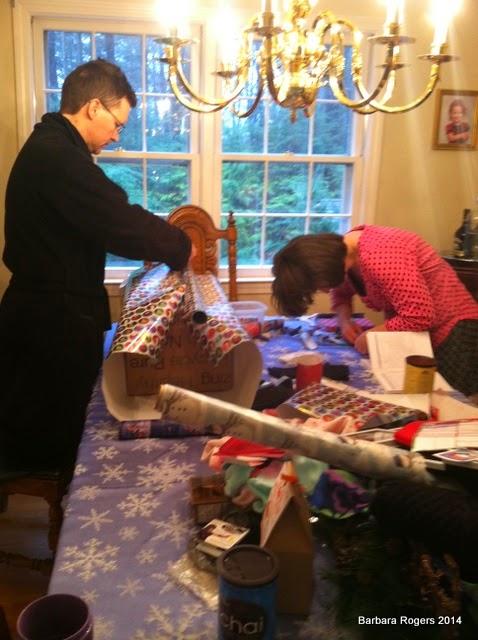
Not only all the presents to prepare for an extended family, but a dinner at a family member's home nearby, with lots of people to take presents for that occasion!

Fortunately this year, this household is going to grandma's for Christmas dinner.  So today's cooking was just a batch of gingerbread cookies (for Santa of course.)  That was after my 10-year old granddaughter made waffles for breakfast!


The house where tonight's party was held!

Our hostess
Our host holding his youngest son while oldest looks on
A right Jolly old Elf

She trimmed the carrots for the reindeer

And arranged them in an "R" on the front porch
While the littlest peeled the paper off the candy cane

Which promptly melted in the hot cocoa that had been prepared by sister number 2
Yes there are the gingerbread men for Santa as well.

Hair and teeth brushed and ready for...
A shared reading of the Night Before Christmas...then to bed for the kids, and you know the other little mice tiptoed around late into the night, aka parental Santa impersonators.