Update about blog

The canyon behind my son’s house in Cortez CO.
Showing posts with label archaeology. Show all posts

Friday, May 22, 2026

What this says

Venus figure created about 25,000 years ago from the Kostenki-Borshevo region on the Don River, north of the Black Sea.

Kostenki / Kostienki is a very important Paleolithic site on the Don River in Russia. It was a settlement which contained goddess figures, dwellings made of mammoth bones, and many flint tools and bone implements. Actually it is not a single site but really an area on the right bank of the Don River in the region of the villages of Kostenki and Borshevo, consisting of more than twenty site locations, all dating to the Paleolithic.


Just think how someone spent hours creating this lovely figure.

And I look at the features of her body, and am aware that the artist was celebrating the woman/goddess who gave life and nurtured it. The model for the figure was well fed, quite capable, and yet her own facial features weren't considered important. 

Would a person of that era find this a turn-on sexually? Or would the figure represent the highest respect for women and perhaps even goddesses! At least this type of body was considered beautiful. Since there are so many similar small figures found in the same area, it's likely that many people made these for an unknown reason...maybe by women as well as men who crafted them. That they were numerous suggests that they had importance in that culture. Early archaeologists thought they were fertility icons. Now they are open to interpreting them as goddesses in a matriarchal society.

The pyramid of patriarchy had not yet taken over society. 

--------------
 
Matriarchy isn’t women on top, it’s a circle with children and the vulnerable at the center.
It is not a mirror image of patriarchy, nor a reversal of domination. Matriarchy is rooted in care, responsibility, and collective survival. Power is not hoarded at the top—it flows outward, guided by the needs of those who require protection the most. Leadership is measured by nourishment, not control. Strength is shown through safeguarding life, honoring interdependence, and valuing empathy as intelligence. In this structure, women do not rule over others; they steward communities. It is not about supremacy, but balance—where dignity is preserved, harm is minimized, and humanity is sustained.
as posted by Claudia Frasca-Jones on Facebook in "She's of Love"
------------------------------

And somehow our civilization discovered mechanical tool making, so craftsmanship moved more rapidly, and many people became specialized in their creativity. I'd guess that of all these men in the photo below, a few of them would be able to carve a venus to exemplify their own paragon of virtue and beauty.
Sharing with Sepia Saturday.


I don't know at this point what the 25,000 year old figure was made of, and am assuming a carved bone of some kind. 

---------------------

At the grand opening of the new Town Hardware last weekend, I saw a wood carver who used a completely industrial age tool. The chain-saw.


Though I totally support crafts...these aren't things that speak to me.


“The greatest revolution of our time is in the way we see the world. The mechanistic paradigm underlying the Industrial Growth Society gives way to the realization that we belong to a living, self-organizing cosmos.” ~Joanna Macy

Thursday, February 26, 2026

How we lived back then...

 Our ancestors, that is.


Model of home in settlement of Çatal Hüyük; (from Turkish çatal "fork" + höyük "tumulus") It is a tell (a mounded accretion resulting from long-term human settlement) of a very large Neolithic and Chalcolithic proto-city settlement in southern Anatolia, which existed from approximately 7500 BC to 5600 BC and flourished around 7000 BC, Turkey (Thanks Wikipedia)

See a post earlier about Archaeology, one of my interests! 

Clay goddess figurine from the Early Chalcolithic period ca 5000-4500 BC, found at the archaeological site of Durankulak, Bulgaria.


It's interesting to see what has been made of clay, stone and bone. Fiber arts, even clothes of skins, unfortunately just don't survive through  the ages.


The Columbus Hypocrisy (and all Western European explorers/invaders).


Justice is often difficult to find.

But just look at all your ancestors!


You do the math...we're all related!

To seek understanding before taking action, yet to trust my instincts when action is called for. Never to avoid danger from fear, never to seek out danger for its own sake. Never to conform to fashion from fear of eccentricity, never to be eccentric from fear of conformity. 

-Steven Brust, novelist (b. 23 Nov 1955)


Arundhati Roy once said, “There’s no voiceless, there’s only the deliberately silenced, you know, or the purposely unheard.”

Wednesday, February 12, 2025

Ancient places


12,000 year-old Gobekli Tepe, the world oldest temple. Carbon dated to just after the last Ice Age. Urfa, Turkey.

An archeological dig which takes the history of gathered groups of creative persons back further in time than had been previously considered.


More recent history: Neuschwanstein Castle - Germany


I believe this is a taxonomy of life forms on earth


Manatees at Three Sisters Spring Photo by Emily Jung. USFWS. Some of the wonderful gentle giant animals around us.


Dating back 4,000 years, the Hingston Hill Cairn and Stone Row on Dartmoor in Devon

Inca  Archtecture

----------

Closer to home: Met the maintenance man in his car as I came home from grocery yesterday. Asked him if he quit...and he said no, that was just a misunderstanding. (It's possible that he did and they talked him into staying, but he didn't want to say that.) (I mentioned how devastated the residents and I were when we heard he quite HERE.) So I gave him a tip, because he does have to be out following his back surgery. He wanted to refuse it, but I mentioned I'd finally gotten my FEMA check from loss of food when disaster hit...so I'd certainly already purchased food to replace it.  I told him it was from "pay it forward." Actually I have received that much probably from strangers who did the same.
----------------------


Sharing with (almost)  Wordless Wednesday 


------------

Today's quote;


Today's art:

Reconstruction based on the Original fresco, preserved at Museum of Prehistoric Thera, Santorini. Minoan Lady Fresco (17th Century BC), from Room 1 of the House of the Ladies in Akrotiri Thera, today's island of Santorini, Greece.


Saturday, February 10, 2024

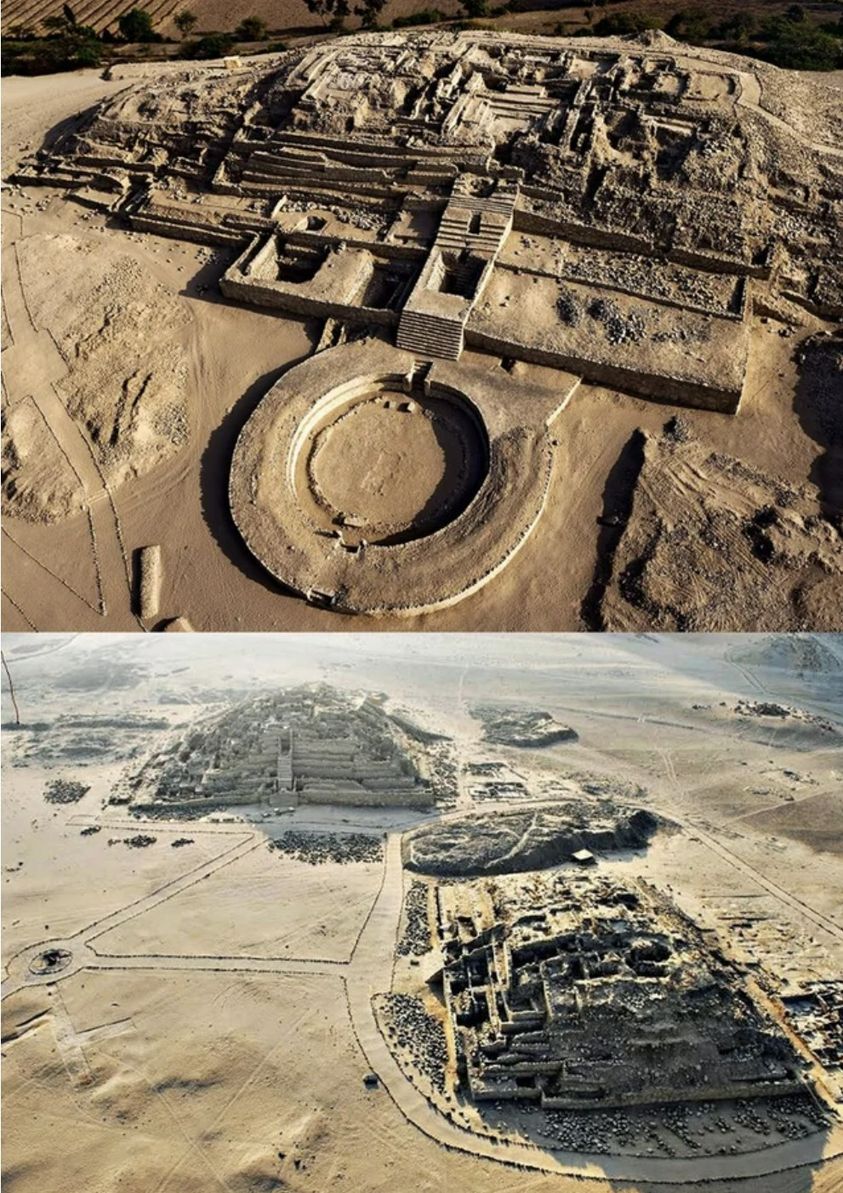
Caral-Supe Peru - occupied between 2600-2000 BC

 Another ancient South American civilization!


The Sacred City of Caral-Supe in Peru, is at least 5000 years old. It includes 6 pyramids, the largest of which measures 150x160 meters (about 492x525 feet).
Caral-Supe, also known simply as Caral, is one of the oldest known civilizations in the Americas, located in the Supe Valley in present-day Peru. It is remarkable for being part of the Norte Chico civilization, a complex pre-Columbian society that flourished between the 30th and 18th centuries BCE. This makes Caral one of the oldest centers of civilization in the world, contemporary with the rise of urbanism and statehood in Mesopotamia, Egypt, and the Indus Valley.
Caral is considered to be the most ancient city in the Americas, with radiocarbon dating indicating that the site was occupied approximately between 2600 BCE and 2000 BCE.
The city is known for its sophisticated urban planning and monumental architecture, including six large pyramid structures, residential areas, plazas, and an amphitheater. The largest pyramid is known as the Pirámide Mayor.
The Caral-Supe civilization was a complex society with a strong emphasis on agriculture, fishing, and trade. The absence of fortifications and weapons suggests a peaceful coexistence among the inhabitants and with their neighbors. Their economy was based on the cultivation of cotton (for fishing nets), squash, beans, and guava, and they engaged in trade with distant regions.
The people of Caral-Supe are credited with significant achievements, including the development of quipu (a system of knotted strings used for record-keeping and communication), advanced knowledge of astronomy, and hydraulic engineering techniques for irrigation.
Its recognition as a UNESCO World Heritage Site underscores its global importance as a cultural treasure.


Wikipedia adds this:

Caral-Supe civilization

"...included as many as thirty major population centers in what is now the Caral region of north-central coastal Peru. The civilization flourished between the fourth and second millennia BC, with the formation of the first city generally dated to around 3500 BC, at Huaricanga.

"Since the early 21st century, it has been recognized as the oldest-known civilization in the Americas, and as one of the six sites where civilisation separately originated in the ancient world.

As often happens, Ruth Shandy was the Peruvian Archaeologist, who partnered with an American couple, Jonathan Haas and Winifred Creamer, in hopes of obtaining more funding. However the Americans then published the find under their names, and only gave Shandy a footnote, so Shandy sued them for plagiarism.

"Haas and Creamer were cleared of the plagiarism charge by their institutions. The science advisory council of the Chicago Field Museum of Natural History rebuked Haas for press releases and web pages that gave too little credit to Shady and inflated the American couple's role as discoverers."